


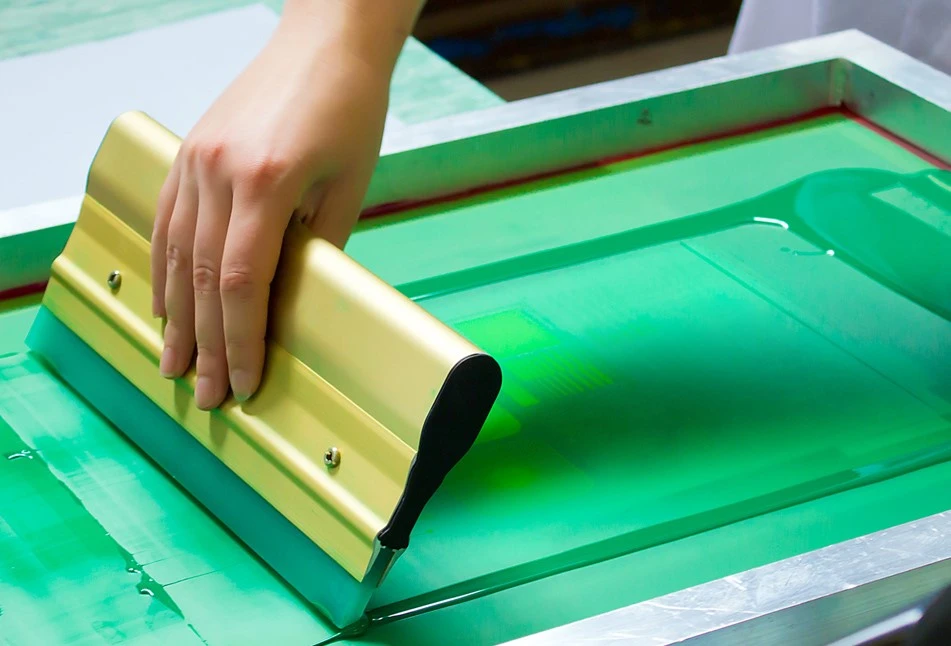
In the fields of packaging, electronics and automotive decoration, the printing and bonding of low surface energy substrates such as polyolefin plastics, metal coatings and composite materials has long plagued the manufacturing industry. Traditional UV inks are prone to problems such as poor adhesion, poor leveling and incomplete curing. Especially in screen printing, insufficient substrate wettability directly leads to fatal defects such as ink shrinkage, edge warping and even delamination.15 Behind these challenges is the fundamental contradiction between the surface tension of the substrate and the permeability of the ink.
1. Industry pain points: The ultimate challenge of difficult-to-attach substrates
Insufficient substrate wettability is the primary bottleneck. For example, when UV ink is printed on PE, PP or certain metal coatings, surface tension mismatch causes the ink to shrink into beads and whiten the edges. Evonik's experimental data shows that the surface tension of ordinary UV varnish on PC substrates is more than 28 dynes, while TEGO® Glide B 1484 additive can reduce it to 21.33 dynes, significantly improving wettability - but additives alone cannot solve the fundamental problem.
Insufficient deep curing is caused by interference from pigments and fillers. Pigments such as carbon black absorb ultraviolet rays, causing the bottom layer to fail to cure. Bora Carbon Black's research confirms that UV systems using high surface area carbon black need to be paired with thioxanthone photoinitiators (such as ITX) or low-structure carbon black (such as Raven 1060U) to balance color concentration and curing depth.
Deformation of heat-sensitive substrates cannot be ignored either. Although UV-LED curing can reduce the impact of heat, if the resin shrinkage is too high (>8%), it will still cause PET film or IMD injection molding to warp. In a UV board production case, the main reason for the delamination of resin and density board is the imbalance between thermal shrinkage stress and substrate adhesion.
2. Core breakthroughs of high-performance UV resins
In response to the above pain points, Shenzhen U-Sunny launched T-7128 modified UV resin to achieve performance leaps through molecular structure innovation:
Adhesion anchoring technology
The polar carboxyl and epoxy groups introduced in the resin can form chemical hydrogen bonds with the surface of the substrate. Experiments show that its adhesion to PC and metal reaches ISO 0 level, and there is no peeling even after hot and cold cycles at -40℃~85℃.
Leveling and wetting synergistic optimization
The viscosity curve of T-7128 shows shear thinning characteristics (static viscosity 8500cps at 25℃, reduced to 1200cps at a shear rate of 1000s⁻¹), allowing the ink to level quickly without bleeding. With 0.1%~0.5% wetting additives (such as TEGO® Wet 270), mirror-like effects can be achieved on ABS substrates.
Low temperature deep curing capability
The acrylic polyurethane skeleton is used in combination with the BAPO photoinitiator system to increase the curing depth to 150μm (365nm light source, 800mJ/cm²). Even for inks containing 15% carbon black, full layer crosslinking can still be achieved.
3. T-7128 resin performance
|
performance index |
T-7128 performance |
The significance of vacuum electroplating primer |
|
main application |
Vacuum electroplating primer main resin |
Core film-forming substance |
|
Curing method |
UV light-cure |
Rapid solidification, energy saving and environmental protection (low VOC) |
|
Base material adhesion |
Excellent (especially for PC, PC+ABS, metal and other difficult substrates) |
Ensure that the coating does not fall off |
|
levelling property |
excellent |
Get high gloss, mirror effect, no defects |
|
High temperature and humidity resistant |
Excellent (e.g. 85°C/85%RH test passed) |
Ensure that the coating of the product is stable in harsh environment, no bubbling and delamination |
|
chemical resistance |
Excellent (resistant to alcohol, gasoline, etc.) |
Meet daily cleaning or specific contact requirements |
|
flexibility |
good |
Adapt to substrate deformation and reduce the risk of coating cracking |
|
Recommended application areas |
High-end cosmetics packaging, consumer electronics, automotive accessories |
Meet high appearance and durability requirements |
4. System Solution: Collaborative Innovation Beyond Single Resin
To completely conquer difficult-to-attach substrates, it is necessary to build a "resin-additive-process" trinity system:
Pretreatment enhancement: Corona treatment (>42 dynes) or plasma activation is used for PP/PE substrates to increase adhesion by 300%;
Functional additive combination: Wetting agents are selected as recoatable TEGO® Wet 270 (medium tension reduction ability) or cross-linked TEGO® Rad 2300 (excellent chemical resistance);
Curing process optimization: UV-LED point light source (365nm+405nm combination) combined with nitrogen protection to inhibit surface stickiness caused by oxygen inhibition.
Shenzhen U-Sunny's T-7128 resin is not only a material breakthrough, but also provides the ultimate bonding solution for automotive IMD trims, electronic touch modules, and high-end cosmetic packaging. Its value lies in transforming "impossible to bond" substrates into high-value-added products that can be mass-produced - just as a customer said after realizing relief printing on metallized PET: "The terminator of the adhesion problem, firmly locking the substrate from the first layer of primer."