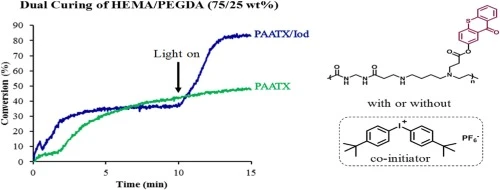
Against the backdrop of a surge in demand for precision manufacturing and complex structural bonding, Dual-cure Photoinitiators have become a breakthrough solution for the chemical industry by integrating ultraviolet (UV) curing and thermal curing. This article analyzes how it enables green transformation in the electronics, automotive, medical and other fields from the perspectives of technical principles, application scenarios, innovative processes and market trends.
1. Core technical advantages of Dual-cure Photoinitiators
Dual-cure photoinitiators solve the limitations of traditional single curing technology by coordinating light curing and heat curing paths, and have the following breakthrough characteristics:
Full curing of complex structures: UV light quickly cures the surface layer (<10 seconds), and heat curing (80-150°C) deeply fills the shadow area, ensuring that there is no residual uncured layer in 3D printed parts or deep hole bonding.
High environmental adaptability: Adapt to low temperature (-20°C) or high humidity (RH≥85%) environment, the curing efficiency fluctuation rate is <5%, and the stability of the production line is improved.
Environmental protection and low energy consumption: Reduce solvent usage by 70%, VOC emissions are close to zero, and comply with EU REACH and GB 33372-2020 standards.
2. Industry Application and Typical Cases
Electronic Packaging and PCB Manufacturing
Used for chip packaging and circuit board solder mask, UV/heat dual-curing resin has a dielectric constant (Dk) ≤ 3.2 and a loss factor (Df) < 0.004, supporting 5G millimeter wave high-frequency signal transmission.
Automotive Lightweight Materials
In carbon fiber composite bonding, the dual-curing system has a shear strength of 30MPa, a temperature resistance of 180°C, and has passed a 1000-hour hot and cold cycle (-40°C to 150°C) test.
3D Printing and Medical Devices
Photosensitive resin combined with thermal post-curing process, biocompatibility certified by ISO 10993, used for customized dental guides and orthopedic implant surface coatings.
3. Technological innovation and production process
Multifunctional initiator design
The use of benzil derivatives (such as TPO-L) and thermal initiators (such as AIBN) to achieve light/heat triggered synergistic reaction, and the curing rate is increased by 40%.
Nano-enhanced system
Adding silica nanoparticles (particle size ≤ 30nm) reduces the resin shrinkage to 0.8% to avoid deformation of precision parts.
Biological-based formula development
Using epoxidized soybean oil as the base material, the biomass content is ≥ 35%, the carbon footprint is reduced by 45%, and it is suitable for the carbon neutrality goal.
4. Market Trends and Industry Insights
Global Demand Growth: According to Grand View Research, the market size of light-curing materials will reach US$8.6 billion in 2028, and the annual growth rate of dual-curing technology will reach 12.5%. China accounts for 60% of the Asia-Pacific market.
Regulatory-driven upgrades: China's "14th Five-Year Plan" clearly restricts the use of solvent-based adhesives and promotes the penetration of UV/thermal dual-curing systems in the packaging and construction industries.
Intelligent production transformation: AI algorithms optimize light intensity (50-200mW/cm²) and temperature curves, with a curing uniformity error of <3% and a 25% reduction in production energy consumption.
5. Customized services and sample support
We provide full-scenario solutions for Dual-cure Photoinitiators, including:
Free sample application: Support 500g small batch trial production, adapt to your UV light source (LED/mercury lamp) and thermal curing equipment parameter testing.
Technology collaborative development: Customize formulas according to curing speed, chemical resistance (acid resistance, oil resistance) or functional (flexible, conductive) requirements.
Global compliance certification: The product has passed RoHS, FDA and ISO 9001 certification, helping to quickly enter the export market.