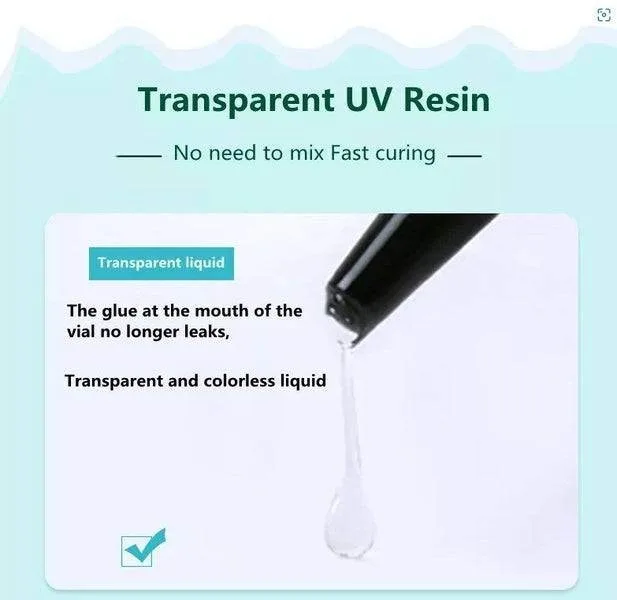
Driven by Industry 4.0 and green manufacturing, UV curing technology is evolving towards lower energy consumption and higher efficiency. Fast Curing UV Resin 300-400mj achieves second-level curing at extremely low energy of 300–400 mJ/cm² by optimizing the photoinitiator system and resin formula, becoming a benchmark solution in the fields of precision electronic packaging, thin film printing and 3D printing.
U-9100A series resins launched by Shenzhen U-Sunny Technology, as a representative product of this technology, are compatible with 365–405 nm LED light sources, and the curing speed is 40% higher than that of traditional systems. It has been successfully applied to automotive optical coatings, flexible circuit packaging and other scenarios, helping customers reduce energy consumption costs by more than 30%.
Technological breakthroughs and performance advantages
1. Synergistic effect of low energy consumption and high-speed curing
U-Sunny U-9100A resin achieves efficient curing at 300-400 mJ/cm² energy through the following innovations:
Hybrid initiation system: Combining the dual mechanisms of cations (iodonium salts) and free radicals (benzil derivatives) to shorten the induction period and improve the reaction activity.
Wide wavelength compatibility: Adapting to LED long-wave light sources (395-405 nm), the utilization rate of light energy is increased by 25%, reducing the cost of equipment upgrades.
Low shrinkage characteristics: Volume shrinkage rate <1.5%, ensuring the dimensional stability of precision devices (tolerance ±10 μm).
2. Environmental adaptability and multifunctional expansion
Deep curing ability: Can penetrate 5 mm thick transparent substrates, curing degree >95% (FTIR detection), suitable for multi-layer electronic packaging.
Moisture and heat resistance: 1,000 hours at 85°C/85% RH, hardness retention rate >90% (ISO 7619-1), meeting automotive electronics standards.
Adjustable mechanical properties: By adjusting the monomer ratio, the modulus range is 0.5–2.5 GPa, which is suitable for flexible circuits and rigid structures.
3. Green manufacturing compatibility
Solvent-free formula: VOCs content <50 ppm, compliant with EU REACH and RoHS regulations.
Energy efficiency: 70% energy saving and 40% carbon footprint reduction compared to traditional mercury lamp curing systems.
Industry applications and typical cases
1. Automotive optical coatings
For headlight lenses and touch panels, U-9100A resin achieves 2-second curing at 380 mJ/cm² energy:
Performance parameters: light transmittance > 92% (550 nm), pencil hardness ≥ 3H, scratch resistance passes 10,000 steel wool tests (ASTM D2486).
Customer case: After a German car company adopted it, the production line efficiency increased by 35%, and passed the Volkswagen TL 52848 certification.
2. 5G high-frequency circuit packaging
In millimeter-wave antenna packaging, the low viscosity (350 cP) property ensures bubble-free filling of microchannels:
Key breakthrough: dielectric loss < 0.003 (10 GHz), signal transmission efficiency increased by 18%.
Mass production data: Under the vacuum potting process, the production capacity reaches 1,200 pieces/hour, and the yield rate is 99.5%.
3. Biomedical microfluidic chips
U-Sunny resin's biocompatibility (ISO 10993 certification) and fast curing properties support precise replication of microchannels:
Performance verification: 100 μm channel accuracy ±2 μm, cell survival rate >99.5%.
Industry certification: Passed FDA 510(k) pre-examination and became the core material of in vitro diagnostic equipment.
Technology Trends and Future Directions
According to MarketsandMarkets, the global low-energy UV resin market will exceed US$2.8 billion in 2027, with a compound annual growth rate of 9.2%. Technology evolution focuses on the following directions:
AI-driven formulation optimization: Dynamically matching the wavelength of the light source with the reaction kinetics of the resin through machine learning, the curing energy consumption is reduced by another 20%.
Development of bio-based monomers: Using renewable raw materials such as itaconate, the carbon footprint is reduced by 35% (U-Sunny has started pilot testing).
Nano-functional integration: Adding MXene nanosheets to improve thermal conductivity (>1.2 W/m·K), and simultaneously optimizing mechanical and electrical properties.
Fast Curing UV Resin 300-400mj is reshaping the process limits of precision manufacturing through the dual breakthroughs of low energy consumption and efficient curing. Shenzhen U-Sunny Technology (U-Sunny) relies on U-9100A series resins and customized solutions to provide global customers with end-to-end services from research and development to mass production. With the explosive growth of new energy vehicles and smart wearable devices, this technology will continue to release innovative value in the fields of green industry and high-precision manufacturing.