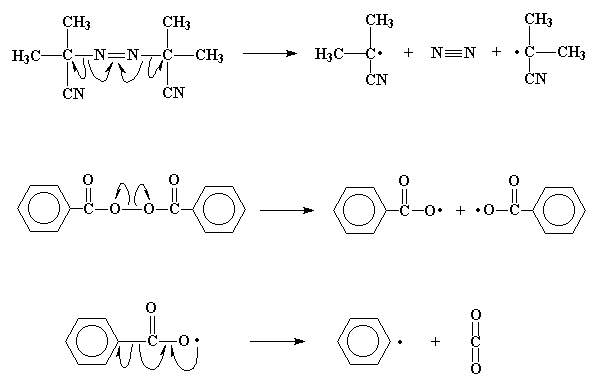
1. Free radical polymerization: the driving force of photocuring reaction
The free radical polymerization mechanism is the core chemical process of UV curing technology. It generates active free radicals through the absorption of ultraviolet light by photoinitiators, triggering the chain reaction of resin monomers and realizing the instantaneous transformation of materials from liquid to solid. This mechanism includes three key stages: initiation → growth → termination, in which the photoinitiator (such as Uyracure-180) generates primary free radicals under photolysis and becomes the "igniter" of the entire reaction.
Technical advantages:
- High rate: The chain reaction makes the polymerization speed more than 100 times faster than traditional thermal curing, which is suitable for industrial continuous production.
- Controllability: By adjusting the light intensity and initiator concentration, the curing depth and cross-linking density can be accurately controlled.
- Wide adaptability: It can initiate the polymerization of various monomers such as acrylates and epoxy resins to meet the needs of multiple scenarios.
2. Technological breakthroughs in free radical polymerization in UV systems
1. Solving the problem of oxygen inhibition
Free radicals are easily quenched by gases, causing the surface to become sticky. The industry has broken through the limitations through the following solutions:
- Inert atmosphere encapsulation: Curing in a nitrogen or carbon dioxide environment to block oxygen contact.
- Co-initiator system: Add amine additives (such as DETX) to regenerate active free radicals through hydrogen transfer reactions.
- Surface enrichment technology: Develop a gradient curing formula to make the surface initiator concentration higher than the internal one, and prioritize surface polymerization.
2. Deep/thick layer curing optimization
For thick coatings or paint systems, two-photon absorption initiators or segmented exposure processes are used to achieve deep and uniform curing using the diffusion effect of free radicals to avoid performance defects caused by uncured bottom layers.
3. Industry Application: A Leap from Theory to Practice
1. Highly Wear-Resistant Coatings
In wood paint and automotive varnish, the three-dimensional cross-linked network formed by free radical polymerization gives the coating extremely high hardness (up to 5H pencil hardness), while adjusting flexibility by controlling the amount of chain transfer agent to solve the contradiction between hardness and impact resistance.
2. Flexible Electronic Printing
Using the controllable properties of free radical activity, low-temperature curing (<80°C) of silver paste circuits on PI (polyimide) substrates is achieved to avoid high temperature damage to flexible substrates, and promote the manufacturing upgrade of conductive circuits for folding screen mobile phones.
3. Biomedical Materials
Photocurable hydrogels construct bionic microstructures through free radical polymerization, which are used as drug sustained-release carriers or tissue engineering scaffolds. The balance between their polymerization rate and cell survival rate has become a research hotspot.
4. Future Trends: Mechanism Innovation Drives Technological Revolution
1. Visible Light Initiation System
Develop photocatalysts such as iridium/ruthenium complexes to extend the initiation wavelength to the 450nm blue light region, reduce the potential harm of ultraviolet light to the human body and materials, and open up new scenarios such as instant sterilization adhesives in operating rooms.
2. Intelligent Response Materials
Combined with reversible addition-fragmentation chain transfer (RAFT) polymerization, light/heat dual response materials are prepared to achieve coating self-repair, shape memory and other functions, which are applied to intelligent packaging and soft robots.
3. Computational Chemistry Assisted Development
Predict the free radical diffusion path through molecular dynamics simulation, guide the initiator molecule design, and shorten the new product development cycle. For example, the initiator conjugated structure is optimized according to the characteristics of UV-LED light sources to improve energy utilization efficiency.
The free radical polymerization mechanism is not only a chemical language to explain the UV curing phenomenon, but also the underlying logic to promote industrial upgrading. From precision electronics to biomedicine, the deep control of chain initiation rate, termination mode and other mechanisms is constantly expanding the boundaries of photocuring technology. In the future, as controlled/active free radical polymerization technology matures, material systems that are both efficient and intelligent will reshape the possibilities of the manufacturing industry.