


The evolution of tempered glass bonding technology directly affects product performance in the fields of electronic equipment, building curtain walls, and automobile manufacturing. Although traditional adhesives (such as epoxy resins) and pressure-sensitive adhesives are widely used, they have pain points such as slow curing, easy yellowing, and poor weather resistance. UV-curing adhesives are becoming the preferred solution for tempered glass bonding due to their fast curing (completed in seconds), no solvent pollution, and excellent adhesion.
1. Comparative analysis of tempered glass bonding materials
Limitations of traditional inks and adhesives
High-temperature glass inks (such as conductive silver paste for automotive glass) require sintering at 620-780℃, which consumes high energy and is not suitable for precision electronic components;
Although the process of pressure-sensitive adhesive is simple (finger pressure bonding), it has low bonding strength and poor temperature resistance, which can easily lead to glass debonding;
Two-component epoxy resin requires several hours to cure, and curing shrinkage can easily cause glass stress cracking.
Breakthrough advantages of UV adhesives
Light-curing technology achieves curing in seconds, increasing production efficiency by more than 5 times;
Zero VOC emissions, avoiding glass surface pollution;
High and low temperature resistance (-40℃ to 120℃) and boiling water resistance, ensuring long-term outdoor stability..
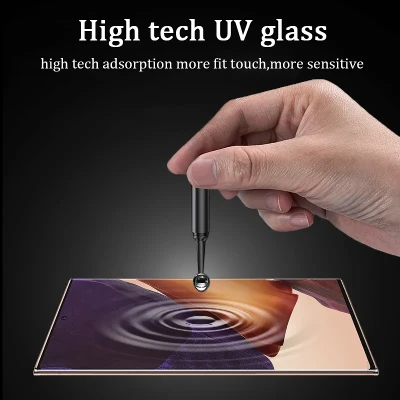
2. Shenzhen U-Sunny T-7131 resin: core material of low shrinkage UV adhesive
For the stress-sensitive problem of tempered glass bonding, Shenzhen U-Sunny's T-7131 trifunctional polyurethane acrylate resin provides a revolutionary solution:
Shrinkage reduced by 40%: molecular structure optimization reduces solidification volume change and avoids glass microcracks;
Strong adhesion without coupling agent: 100-grid test reaches 5B level, directly bonding float glass/tempered glass;
Multi-functional application adaptation:
As the main resin of UV adhesive, it realizes high-strength glass-metal bonding (such as mobile phone screen packaging);
For UV glass ink, it provides 5-6H pencil hardness and 30-day water immersion resistance.
3. Industry Trends and Technological Innovation
The UV curing material market is growing rapidly
The global UV curing system market is expected to reach US$13.7 billion in 2030, with a compound annual growth rate of 18.9%. The driving factors include:
Demand in the electronics industry: high-precision UV adhesive (such as PUR hot melt adhesive) is required for bonding narrow-frame equipment;
Environmental policy promotion: low VOC characteristics comply with EU REACH regulations.
Cross-field application of T-7131
Building curtain wall: compounded with silicone adhesive to improve the bonding strength of tempered glass-square steel;
Automotive glass: weather-resistant protective ink extends the life of windshields;
3D printing: supports rapid prototyping of photocurable resins.
Conclusion
As UV curing technology evolves towards low shrinkage and high weather resistance, innovative materials such as Shenzhen U-Sunny T-7131 resin will continue to enable efficient bonding of tempered glass. Its environmentally friendly characteristics and multi-scenario adaptability will provide sustainable solutions for the manufacturing industry.