1. Effect of oxygen inhibition on UV radiation curing
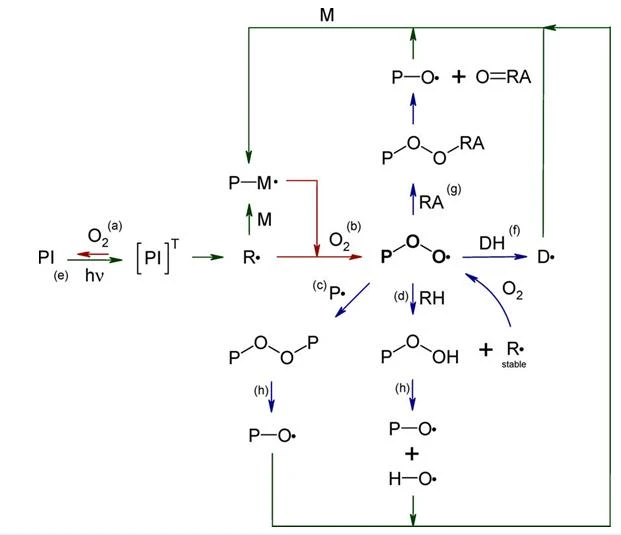
Oxygen inhibition is very harmful to the UV curing process. The radiation curing reaction of almost all radiation curing materials will be affected by oxygen in the air. The concentration of oxygen in oily organic systems is usually less than or equal to 2×10 3 mol/L. Not only the formula system The dissolved oxygen molecules in the coating hinder polymerization. During the photoinitiation process, with the consumption of oxygen molecules in the curing system, oxygen in the air on the surface of the coating can also quickly diffuse into the cured coating, continuing to hinder polymerization. Since the concentration of oxygen is the highest in the surface layer, the inhibitory effect of oxygen often causes the lower layer to be cured but the surface remains uncured and becomes sticky. Tests have proven that for varnish , curing a 1 μm thick coating in the air consumes 20 times more energy than curing a 1 μm thick coating within the coating (5 μm from the surface). The inhibitory effect of oxygen not only prolongs the radiation curing time, but may also damage important properties of the cured surface such as hardness, wear resistance, and scratch resistance.
2 Several ways to solve the problem of oxygen inhibition
2.1 Appropriately increase the initiator concentration or increase the radiation dose
2.1.1 The inhibitory effect of oxygen can be greatly alleviated by optimizing the initiator concentration by increasing the initiator concentration. Select several initiators with different absorption peaks. Strong absorption can be used to offset the effect of oxygen, while weakly absorbing light can enter the bottom layer and polymerize the bottom resin. However, high-concentration initiator content will cause problems such as residual odor and yellowing caused by the reaction of the initiator itself.
2.1.2 In many cases, it is to increase the radiation energy and increase the power or number of UV lamps. Increasing the radiation intensity can reduce the impact of oxygen's inhibitory effect, but increasing the UV radiation intensity will increase the thermal radiation effect in proportion, which is limited in the application of some papers, films, and some plastic substrates that are susceptible to thermal deformation.
2.2 Add oxygen scavenger
2.2.1 Use tertiary amines, mercaptans, phosphine compounds, etc. As active hydrogen donors, these compounds can react quickly with peroxyl radicals to regenerate active free radicals . At the same time, peroxyl radicals abstract hydrogen to generate alkyl hydroperoxide, and can further generate alkoxy radicals and hydroxyl radicals. However, the cured products of systems containing amines are prone to yellowing, and the storage stability of the system is poor. Adding oxygen scavengers such as hindered amines and hindered phenols to light-curing formulas does not actually help improve photopolymerization, and sometimes inhibits polymerization. Its actual role should be understood as long-term light stabilization and thermal stabilization of polymer materials, which is often referred to as polymer light stabilizer.
2.2.2 By using physical methods, such as inert gas protection, floating wax, coating, strong light irradiation, step-by-step irradiation, etc. to improve the curing process, although the impact of oxygen inhibition on the properties of the cured film can be avoided, the operation process is more troublesome . , affecting production efficiency.
2.3 Cationic polymerization reaction
Oxygen has a diradical structure, which only inhibits free radical polymerization and is insensitive to cationic polymerization. The cationic curing mechanism is not inhibited by oxygen in the air . The combination of free radical type and cationic type can make up for each other's weaknesses. The hybridization of both the acrylate group with free radical curing mechanism and the vinyl group with cationic curing mechanism can produce a hybrid photo-curing system with good synergy. Cationic photoinitiators, such as diphenyl iodide salt and triphenyl sulfide salt, produce cations through photolysis while also generating free radicals, thus promoting the progress of free radical polymerization. At the same time, free radical photoinitiators can also effectively sensitize onium salts . Free radical photoinitiators can sensitize salts through direct transfer or indirect transfer of electrons. Therefore, the combined use of free radical photoinitiators and cationic photoinitiators has a significant synergistic effect and is suitable for free radical-cation hybrid UV curing systems.
3. Polymerization of vinyl ether monomers
3.1 Double bond properties of vinyl ether monomers
Due to the influence of the adjacent oxygen atoms, the double bonds in the vinyl ether monomer are electron-rich double bonds, which can undergo free radical alternating copolymerization with maleic acid and fumaric acid unsaturated polyesters. Vinyl ether is an electron-rich substance. Maleic acid is an electron-deficient substance that can form a charge transfer complex CTC when excited, thereby initiating free radical polymerization.
3.2 Cationic polymerization of vinyl ether monomers
Vinyl ether monomers contain electron-rich double bonds and can easily form stable carbocations, making them prone to cationic polymerization. Oxygen-free polymerization inhibition, fast reaction speed. The extremely low viscosity and excellent dilution ability form long chain segments in the cross-linked network , increasing the free space of the curing system. It has post-curing reaction ability, which is conducive to the continued movement and reaction of unpolymerized components and chain segments , and the final conversion rate is extremely high. Low toxicity and no skin irritation. Compared with free radical initiation, cationic initiation does not form peroxide, so it is less prone to yellowing.
3.3 Free radical polymerization of vinyl ether monomers
Vinyl ether monomers can also undergo free radical homopolymerization, avoiding the influence of moisture on cationic polymerization. However, in the free radical curing system, the ability of vinyl ether to overcome oxygen inhibition is also excellent. The application of vinyl ether under the conditions of extremely low film thickness and low curing energy shows excellent curing performance. When combined with a wide variety of acrylate oligomers, the final reaction rate and conversion rate are higher than those of a single free radical or cationic curing system, allowing the best performance of the polymer to be fully utilized. It has positive performance in enhancing scratch resistance, abrasion resistance and chemical resistance, and can achieve strong and tough protective coating.
(Figure 1: Trust 7020 acrylic oligomer and monomer ratio 5:1, film thickness 50um)