


In the application of sealants at construction sites, the spraying of paints at automobile factories, and the production of cables in electronic workshops, an invisible chemical is playing a key role: silane crosslinkers. These special silicon-based compounds completely change the physical and chemical properties of polymers by forming a strong molecular network, becoming an indispensable "performance enhancer" in modern industry.
The global silane crosslinker market is experiencing significant growth, reaching $1.5 billion in 2024 and is expected to climb to $3.2 billion by 2033, with a compound annual growth rate of 9.0%. This growth is mainly driven by the demand for high-performance materials in the construction, automotive and electronics industries. In particular, in the rapidly industrializing Asia-Pacific region such as China and India, infrastructure construction and the expansion of the automotive industry have made this region the fastest growing market, contributing 35% of the global revenue share.
1 Core Mechanism: How does silane "lock" polymer properties?
Silane crosslinkers have a unique molecular structure and dual reactivity:
Organic reaction ends (such as vinyl, amino, epoxy) can combine with polymer chains
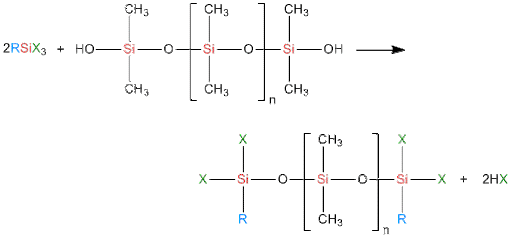
Inorganic siloxane ends (containing hydrolyzable alkoxy groups) form silanols when exposed to water and condense with the substrate or itself
This property makes it a "molecular bridge" between organic and inorganic interfaces. During the crosslinking process, silane forms a durable Si-O-Si bond network between polymer chains, significantly improving three major properties:
Mechanical strength: Improved resistance to deformation and fracture
Thermal stability: Maintain structural integrity at high temperatures
Environmental weather resistance: Anti-hydrolysis, chemical corrosion resistance
2 Analysis of multi-field applications
2.1 Coatings and inks: from adhesion to anti-fingerprint
In the field of coatings, silane crosslinkers solve two core problems:
Adhesion improvement: Enhance the bonding strength of organic resins with inorganic substrates such as metals and glass
Protection performance upgrade: Form a hydrophobic barrier to improve water resistance, wear resistance and weather resistance2
Bis(N-methylbenzamide)ethoxymethylsilane represents a high-end crosslinker with the following characteristics:
Fast cure speed and low modulus
Extremely high elongation (maintains elasticity)
Excellent adhesion to multiple substrates
Applicable to silicone glass glue and room temperature vulcanized rubber
In the field of inks, silicone additives show versatility:
As a water-dispersible polydimethylsiloxane
Reduced friction coefficient (gives a smooth feel)
Provides anti-adhesion and scratch resistance
Especially suitable for water-based wood paint, leather ink, paper varnish6
Anti-fingerprint additives use silicone acrylic polymer technology to achieve dual functions in UV coatings:
Anti-fingerprint contamination
Reduced tape adhesion (easy to tear without leaving glue)
2.2 Adhesives and sealants: a revolution in durability
Silanes play multiple roles in this field: coupling agent, tackifier, crosslinker, water scavenger2. Its value is reflected in:
Reducing viscosity and improving dispersibility of inorganic fillers
Enhancing organic/inorganic interface compatibility
Improving dry and wet bond strength and durability
Preventing premature vulcanization of rubber and extending shelf life
Epoxy-functional alkoxysilanes are particularly outstanding, with crosslinking rates exceeding traditional polyaziridines, polyisocyanates, etc., while improving elongation at break. Studies have shown that the diffusion behavior of silane additives in uncured sealants directly affects the depth of cure and interfacial bonding strength, which is crucial for long-term sealing of substrates such as aluminum and glass.
2.3 Wires, cables and pipes: the "invisible guard" behind safety
Silane crosslinkers are mainly used in this field for the modification of polyethylene (such as PEX pipes) and elastomers:
Improving thermal deformation stability and mechanical strength
Improving electrical properties in humid environments
Enhancing chemical resistance
Allowing higher filler additions (reducing costs)
3 Frontiers of innovative applications
3.1 New energy and electronics
New polysiloxane-based crosslinkers are driving the development of solid polymer electrolytes (SPE):
Poly[siloxane-(g-oligoethylene oxide)-co-acrylate] crosslinker
With PEGDME plasticizer, the ionic conductivity reaches 7.13×10⁻⁴ S/cm
Electrochemical window extended to 5.2V
Thermal decomposition temperature is as high as 350℃
Such materials are expected to solve the safety and energy density bottlenecks of lithium polymer batteries.
3.2 Dipodal silanes: the next generation of high-performance crosslinking
Dipodal silanes represent a technological breakthrough:
Six bonding sites in a single molecule (traditional silanes only have three)
Forming a denser crosslinked network
Significantly improving hydrolysis stability and bonding strength
Such silanes show high selectivity, thermal stability and chlorine resistance in the preparation of mixed silica membranes, and are suitable for seawater desalination membranes and gas separation membranes.
4 Shenzhen U-Sunny's differentiated product strategy
As an important supplier of specialty silanes in China, Shenzhen U-Sunny focuses on the development of functional and environmentally friendly products:
Silanes for environmentally friendly water-based systems: low-VOC crosslinkers suitable for water-based coatings/inks
Fast-curing aminosilanes: shorten the process time of automotive adhesive production lines
Electronic-grade high-purity products: meet the ion purity requirements of semiconductor packaging glue
Its product line covers adhesion promoters, surface modifiers, hydrophobic agents, crosslinkers and other multifunctional additives, in line with the growing demand for green chemicals under China's "dual carbon" policy.
From sealants in skyscrapers to battery electrolytes in smartphones, silane crosslinkers have reshaped the boundaries of materials as "molecular engineers". With the emergence of innovative structures such as bipedal silanes and technological upgrades by Asia-Pacific manufacturers such as Shenzhen U-Sunny, this field will continue to drive the performance revolution of coatings, inks, adhesives, and new energy materials. In the next decade, multifunctional, intelligent, and environmentally friendly crosslinkers will dominate the market and play a key role in sustainable industrial development.