


In the rapidly evolving chemical industry, Thiol-ene click chemistry has emerged as a transformative technology, particularly in adhesives, coatings, inks, and nail gels. This article explores its principles, industrial applications, and the innovative role of Shenzhen U-Sunny's Thiol-30L product in driving sustainable solutions.
What Makes Thiol-Ene Click Chemistry Unique?
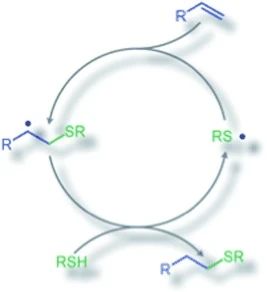
Thiol-ene click chemistry involves the rapid, efficient reaction between thiol (-SH) groups and unsaturated carbon-carbon bonds (C=C) under mild conditions. Its two primary mechanisms-radical-mediated polymerization (UV-initiated) and nucleophilic Michael addition-enable precise control over reaction kinetics and network structures .Key advantages include:
High efficiency: Near-quantitative yields with no byproducts.
Spatiotemporal control: UV initiation allows localized curing, ideal for coatings and 3D printing .
Metal-free: Eliminates toxicity concerns in biomedical and food-contact applications .
Applications in Adhesives and Beyond
Light-Curing Adhesives:
Thiol-ene systems excel in UV-curable adhesives, offering rapid curing (seconds to minutes) and strong adhesion to diverse substrates like metals, plastics, and composites. For example, U-Sunny's Thiol-30L reduces oxygen inhibition, enabling robust curing even in thin films .
Coatings and Inks:
In UV-curable coatings, thiol-ene formulations enhance scratch resistance and flexibility. For inks, they improve print durability and color stability, especially in low-energy LED curing systems .
Nail Gels:
Thiol-ene chemistry enables fast-curing, low-odor nail gels with excellent wear resistance, meeting consumer demand for eco-friendly beauty products .
Biomedical and Electronics:
From hydrogel wound dressings to flexible circuit adhesives, thiol-ene networks provide biocompatibility and thermal stability .
U-Sunny's Thiol-30L: A Game-Changer for Industry
Shenzhen U-Sunny Technology, a leader in photocurable materials for over 20 years, has developed Thiol-30L, a next-generation polythiol curing agent. Key features include:
Low odor and toxicity: Ideal for consumer-facing applications like cosmetics and packaging.
Enhanced oxygen resistance: Mitigates air inhibition in UV curing, reducing energy consumption .
Versatility: Compatible with acrylates, epoxies, and cationic systems, supporting diverse formulations .
This product aligns with global trends toward low-VOC adhesives and aligns with China's policies promoting sustainable chemistry .
Market Trends and Future Outlook
The adhesive industry is shifting toward high-performance, eco-friendly solutions. By 2030, the global demand for UV-curable adhesives is projected to grow at 8% CAGR, driven by electronics, automotive, and renewable energy sectors . Thiol-ene systems, with their adaptability and efficiency, are poised to dominate niches like:
Bio-based adhesives: Integrating renewable monomers like plant-derived thiols.
Smart materials: Stimuli-responsive networks for wearable devices .
Conclusion
Thiol-ene click chemistry is reshaping industrial materials, offering unparalleled precision and sustainability. U-Sunny's Thiol-30L exemplifies this innovation, providing a competitive edge in adhesives, coatings, and beyond. As industries prioritize green chemistry, adopting such technologies will be key to meeting regulatory and consumer demands.