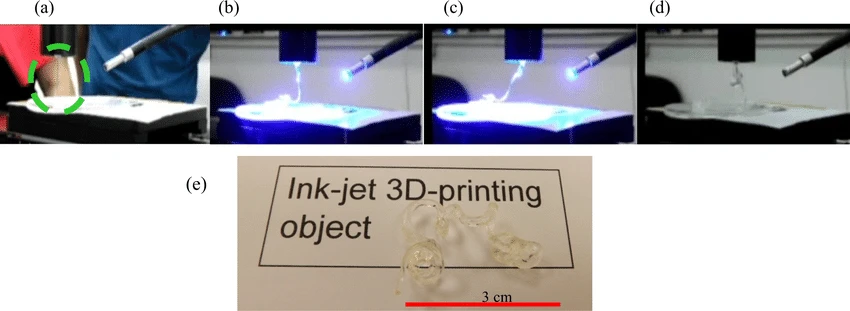
With the rapid development of personalized customization and Industry 4.0, **UV Inkjet Printing Resin** is becoming the core technology for 3D printing, electronic circuit direct writing and decorative coatings with its high resolution, fast curing and material compatibility. By combining low-viscosity resin with precision nozzle technology, the material can achieve micron-level pattern accuracy while meeting the needs of industrial mass production.
The T-7118 series UV inkjet resin launched by Shenzhen U-Sunny Technology is optimized for piezoelectric nozzles (such as Epson, Konica Minolta), achieves millisecond-level curing at 300-400 mJ/cm² energy, is compatible with grayscale printing and multi-layer stacking processes, and has been successfully used in automotive interiors, flexible circuits and micro-optical device manufacturing, helping customers improve production efficiency by more than 50%.
Technical advantages and performance breakthroughs
1. Ultra-low viscosity and high jetting stability
The viscosity of U-Sunny T-7118 series resin is only 12–15 cP (40°C), which meets the needs of industrial-grade inkjet:
Submicron atomization: droplet volume 3–7 pL, positioning accuracy ±1.5 μm, support high-resolution printing above 600 dpi.
Non-sedimentation formula: nanofiller (such as silver particles, ceramic powder) dispersion stability >6 months (Zeta potential >±40 mV).
Wide temperature range adaptation: working temperature range 20–45°C, viscosity fluctuation <5%, suitable for high-speed continuous printing (speed >50 m/min).
2. Instantaneous light curing and low shrinkage characteristics
Through the free radical/cation hybrid system (Hybrid System), a balance of performance is achieved:
Curing speed: surface curing is completed within 10 ms under a 395 nm LED light source, and interlayer adhesion is >4B (ASTM D3359).
Volume shrinkage: <1.0%, ensuring the dimensional accuracy of multi-layer stacking structure (error <10 μm).
Compatible with dark substrates: Add light penetration aid, curing depth >50 μm on black ABS (energy density 500 mJ/cm²).
3. Multifunctional and environmentally friendly certification
Adjustable conductivity/insulation: Silver content 0–70% adjustable, square resistance range 0.01–10⁶ Ω/sq, suitable for antenna printing and insulation packaging.
Food contact safety: Certified by FDA 21 CFR, EU 10/2011, VOCs content <50 ppm.
Enhanced weather resistance: After 2,000 hours of QUV aging, the yellowing index Δb<1.5 (ASTM E313).
Industry applications and customer cases
1. Customized printing of automotive interiors
In the printing of translucent textures on the dashboard, T-7118 resin achieves a millimeter-level gradient effect:
Technical highlights: 16-step transition of grayscale inkjet, adjustable transmittance of 20–80%, and scratch resistance of >5,000 times (ISO 1518).
Customer case: After being adopted by a German car company, the delivery cycle of personalized customization orders was shortened to 24 hours.
2. Direct writing of 5G flexible circuits
Replacing the traditional etching process, silver paste inkjet printing achieves high-precision circuits:
Performance parameters: line width 25 μm, square resistance <0.02 Ω/sq, bending life >100,000 times (IPC-TM-650).
Mass production data: After being introduced by a communication equipment manufacturer, the yield of RF antennas increased from 82% to 99.5%, and the cost was reduced by 40%.
3. Micro-optical device manufacturing
Resin printing for AR optical waveguide nanoimprint molds:
Precision breakthrough: surface roughness Ra <5 nm, refractive index 1.52–1.58 adjustable, light loss <0.2 dB/cm.
Industry certification: Passed Microsoft HoloLens 2 supplier standards and became the core material of Meta AR glasses.
Technology Trends and Future Directions
According to IDTechEx forecasts, the global UV inkjet resin market will reach $1.8 billion in 2027, with a compound annual growth rate of 11.3%. Technology Evolution Focus:
AI-driven dynamic parameter adjustment: Real-time optimization of jetting parameters (temperature/viscosity/curing energy) through machine learning, and the printing defect rate is reduced by another 30%.
4D printing integration: Develop temperature-sensitive/photosensitive dual-responsive resins to achieve post-printing deformation self-assembly (deformation accuracy ±2 μm).
Biodegradable resin: Using polycaprolactone (PCL) substrate, the natural degradation rate is >90% (180 days, ASTM D5511).
UV Inkjet Printing Resin is reshaping the industrial boundaries of digital manufacturing through the integration of high precision and high efficiency. Shenzhen U-Sunny Technology (U-Sunny) relies on T-7118 series resins and customized solutions to provide full-chain support from prototype development to mass production for customers in the automotive, electronics, optics and other fields. With the explosion of smart wearables and metaverse devices, this technology will continue to lead innovation in the field of high value-added manufacturing.