


What is the cation effect
The cation effect refers to the multifaceted influence of cations in electrolyte solutions on electrocatalytic reactions, primarily through the following mechanisms:
First, they alter the hydrogen bond network, affecting proton transport and intermediate adsorption;
Second, they stabilize key intermediates through electrostatic interactions;
Third, they modulate the double-layer electric field, promoting the adsorption of polarizable species and lowering the activation barrier;
Fourth, they embed into the catalyst lattice, altering the electronic structure and regulating catalytic performance;
Five, they buffer the interfacial pH, reducing electrode polarization, inhibiting competing reactions, and improving target product selectivity.
Research has shown that the Gibbs free energy of water adsorption and dissociation decreases with increasing cation size (Li+ > Na+ > K+ > Cs+), indicating that larger cations favor water adsorption and dissociation. This highlights the critical role of cation size and hydration properties in determining adsorption behavior and provides improved strategies for designing efficient catalytic materials.
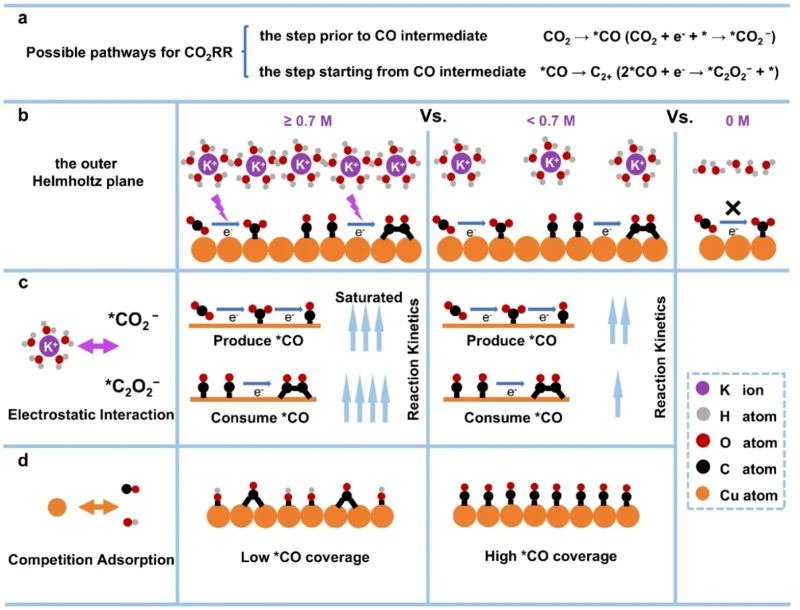
The key role of the cationic effect
Cations can form hydration shells with water molecules, significantly altering the surrounding hydrogen-bonding network. High charge density allows for strong hydration, resulting in a tightly ordered hydrogen-bonding network that facilitates proton transport and is crucial for reducing the HER overpotential.
In contrast, cations such as K+ and Cs+ exhibit weak hydration, disrupting hydrogen-bonding connectivity and maintaining a low-hydration environment, which enhances the adsorption of multistep reaction intermediates (such as those in the CO₂RR). Therefore, selecting appropriate cations to modulate interfacial water distribution and hydrogen-bonding connectivity is an effective strategy for optimizing electrochemical reaction kinetics.
Cations play a key role in electrocatalysis, influencing reaction pathways, selectivity, and efficiency through their electrocatalytic effects. These effects can impact hydrogen-bonding networks, reaction intermediates, the EDL, and the electronic structure of the catalyst. Despite significant progress in understanding these effects through integrated experimental and computational approaches, the mechanisms of cation interactions remain poorly understood and complex. A deeper understanding of these mechanisms is crucial for optimizing electrocatalytic performance.