


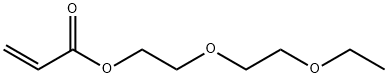
In the chemical industry, 2-(2-Ethoxyethoxy)Acrylate (CAS 7328-17-8) has emerged as a critical monomer, particularly valued for its unique solubility profile and versatility. This article explores its solubility characteristics, industrial applications, and the role of Shenzhen U-Sunny's AM-312 product in advancing performance-driven formulations across coatings, inks, and adhesives.
1. Solubility Profile of 2-(2-Ethoxyethoxy)Acrylate
2-(2-Ethoxyethoxy)Acrylate exhibits excellent water solubility (124–146 g/L at 20°C) , making it ideal for aqueous formulations. Its balanced hydrophilicity and lipophilicity (LogP: 1.151–1.2 at 23°C) allow compatibility with polar and non-polar solvents, enabling tailored solutions for diverse systems. This monomer's low viscosity and high dilution efficiency further enhance its utility in solvent-based and UV-curable applications.
2. Industrial Applications in Key Sectors
Coatings
In the coatings industry, 2-(2-Ethoxyethoxy)Acrylate contributes to low-shrinkage, flexible films . Its solubility supports homogeneous dispersion in waterborne coatings, aligning with the global shift toward low-VOC products. For instance, it improves adhesion and weathering resistance in architectural and automotive coatings .
Inks
The compound's rapid curing and solubility in organic solvents make it a staple in printing inks. It enhances pigment dispersion in solder mask inks and flexographic inks, ensuring sharp prints and durability .
Adhesives
In pressure-sensitive adhesives (PSAs), 2-(2-Ethoxyethoxy)Acrylate enhances tackiness and shear strength. Its solubility in acrylic monomers facilitates crosslinking, critical for high-performance bonding in packaging and electronics .
3. Market Trends and Sustainability Drivers
The global acrylate market is projected to grow at a 6.3% CAGR through 2029, driven by demand for eco-friendly materials . Regulatory pressures, such as VOC emission limits, favor water-soluble acrylates like 2-(2-Ethoxyethoxy)Acrylate. Innovations in bio-based solvents and nano-enhanced formulations further expand its potential in green chemistry .
4. U-Sunny's AM-312: A Benchmark in Performance
Shenzhen U-Sunny's AM-312 product, formulated with 2-(2-Ethoxyethoxy)Acrylate, exemplifies cutting-edge solutions for industrial adhesives and coatings. Key advantages include:
Superior Compatibility: Optimized solubility ensures stable blends with resins and additives.
Enhanced Durability: Reduces film shrinkage by 15–20% compared to conventional acrylates .
Eco-Efficiency: Supports low-VOC formulations, complying with EU REACH and U.S. EPA standards.
AM-312 is widely adopted in electronics, automotive, and construction sectors, underscoring U-Sunny's commitment to innovation and sustainability.
5. Handling and Safety Considerations
While 2-(2-Ethoxyethoxy)Acrylate offers technical benefits, proper handling is crucial. It may cause skin and eye irritation, necessitating PPE like gloves and goggles . Storage in sealed, dry containers at room temperature ensures stability and longevity.
Conclusion
2-(2-Ethoxyethoxy)Acrylate's solubility and multifunctionality position it as a cornerstone of modern chemical formulations. As industries prioritize sustainability, products like U-Sunny's AM-312 will drive advancements in coatings, inks, and adhesives. For tailored solutions leveraging this monomer's unique properties, partnering with innovators like U-Sunny ensures competitive edge in a dynamic market.
By integrating technical expertise with eco-conscious practices, the chemical sector can harness 2-(2-Ethoxyethoxy)Acrylate's full potential-balancing performance, safety, and environmental responsibility.