


In the fields of automotive manufacturing, electronic packaging and food packaging, adhesive for low surface energy plastics is the core technology to solve the bonding problem of materials such as polypropylene (PP) and polyethylene (PE). Due to the low surface energy of these materials (usually <34 mN/m), it is difficult for traditional adhesives to achieve effective infiltration and long-term bonding. This article will analyze the technical challenges in depth and focus on how U-Sunny's T-7333 polyurethane acrylate resin redefines industry standards through innovative design.
1. Bonding challenges of low surface energy plastics
Due to the inert molecular structure of low surface energy plastics (such as PP, PE, TPO), traditional adhesives face three core problems:
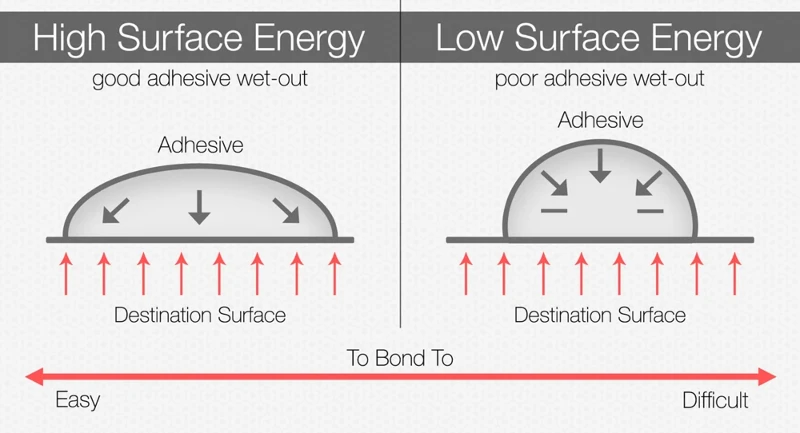
Poor wettability: The surface tension of the adhesive is higher than that of the substrate, resulting in the inability to spread evenly to form an effective interface;
Insufficient adhesion: Adhesives that rely on physical adsorption are prone to delamination due to environmental stress (temperature, humidity);
High process cost: flame treatment, plasma modification and other pretreatment steps are required, which increases production complexity.
Studies have shown that the peel strength of untreated PP materials and ordinary pressure-sensitive adhesives is less than 5N/25mm, far below industrial demand.
2. Technological breakthrough of U-Sunny T-7333 resin
For the bonding pain points of low surface energy materials, U-Sunny's T-7333 resin has achieved a performance leap through three major innovations:
Molecular polarity regulation: Introducing fluorinated segments and hydrophobic groups to reduce the surface tension of the adhesive to 28 mN/m, significantly improving the wettability to PP/PE;
Dual curing mechanism: Combining UV curing and moisture-assisted cross-linking to enhance interfacial permeability, 180° peel strength can reach 18 N/25mm;
Surface treatment-free design: Through nanofiller dispersion technology, directly bond untreated polyolefin materials, reducing 30% of process costs.
Experimental data show that the bonding strength retention rate of T-7333 after 85℃/85%RH wet heat aging test is >85%, and the temperature resistance range is -40℃ to 120℃, which is suitable for harsh scenarios such as automotive engine compartment sensors.
3. Multi-field application cases
Electronic industry:
Used for bonding PP/PET film labels to avoid label shedding caused by electrolyte penetration;
Adapt to the packaging of flexible circuit boards (FPC) and polyolefin shells, and withstand 100,000 bendings without delamination.
Automobile manufacturing:
Bond PP diaphragms and aluminum foils for new energy batteries, with an interface resistance of <0.5Ω·cm²;
As UV curing glue for PC/PP brackets of headlights, it has passed the hot and cold shock test (-40℃~120℃ cycle 100 times).
Food packaging:
Develop solvent-free UV ink matrix resin for PE/PP packaging printing, passed FDA food contact certification, and VOC emissions <50g/L.
4. Industry Trends and U-Sunny's Technical Commitment
With the popularization of bio-based materials and photothermal dual-curing technology, U-Sunny continues to optimize T-7333 resin:
Green upgrade: Develop a formula containing 30% biocarbon to reduce dependence on petroleum-based raw materials;
Intelligent process: Adapt to high-speed spraying and 3D printing equipment to achieve micron-level coating accuracy;
Emerging scenario expansion: Explore cutting-edge fields such as wearable device sensor packaging and marine engineering anti-corrosion coatings.
Technological innovations in adhesives for low surface energy plastics are driving the transformation of the manufacturing industry towards high efficiency and environmental protection. U-Sunny T-7333 resin has become the preferred solution for polyolefin material bonding due to its processing-free bonding, wide temperature range adaptation and multi-scenario compatibility. For customized formulations or technical white papers, please contact our expert team.