


In UV-curable formulations, selecting the right monomer is critical for achieving optimal performance. Two prominent options-DVE-3 (Triethyleneglycol divinyl ether) and TMPTA (Trimethylolpropane triacrylate)-offer distinct advantages depending on the application requirements. This article explores their technical differences, industry use cases, and highlights Shenzhen U-Sunny's VM-3520 (a DVE-3-based solution) as a superior choice for advanced UV systems.
1. DVE-3: High Efficiency in Cationic & Hybrid Systems
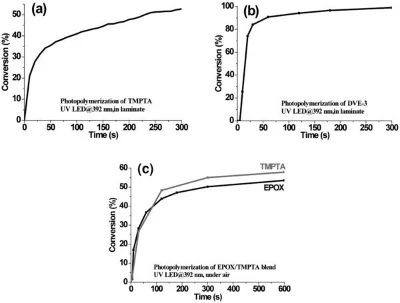
DVE-3 excels in cationic and dual-cure (cationic + radical) UV systems, offering rapid polymerization with minimal shrinkage (<3%) and exceptional double-bond conversion rates (up to 99% under optimized conditions) . Key features include:
Low viscosity (2.64 mPa.s at 25°C): Enhances flowability and resin compatibility, ideal for coatings, adhesives, and 3D printing resins.
Broad compatibility: Pairs effectively with cycloaliphatic epoxy resins for durable, flexible films .
Thermal stability: Maintains performance in demanding environments like automotive electronics and aerospace coatings .
Shenzhen U-Sunny's VM-3520, a premium DVE-3 variant, is engineered for high-precision applications. With rigorous quality control and RoHS/REACH compliance, VM-3520 ensures batch-to-batch consistency and eco-friendly processing .
2. TMPTA: Speed and Crosslinking in Radical Systems
TMPTA is a trifunctional acrylate monomer optimized for radical polymerization, delivering fast curing speeds and high crosslink density. Its strengths include:
Rapid UV curing: Achieves full polymerization in seconds, suitable for high-throughput processes like 3D printing and inkjet coatings .
Mechanical durability: Forms hard, abrasion-resistant films for automotive interiors and industrial equipment .
Market dominance: Widely adopted in electronics and packaging due to its cost efficiency and versatility .
However, TMPTA's higher shrinkage (~5–8%) and oxygen inhibition in thin-film applications limit its use in precision optics .
3. DVE-3 vs. TMPTA: Performance Comparison
| Property | DVE-3 | TMPTA |
|---|---|---|
| Curing Mechanism | Cationic/dual-cure | Radical |
| Shrinkage | <3% | 5–8% |
| Conversion Rate | Up to 99% | 58–61% |
| Viscosity | 2.64 mPa.s | 100–150 mPa.s (typical) |
| Key Applications | Flexible coatings, 3D printing |
Hard coatings, adhesives, inks |
DVE-3 outperforms TMPTA in low-shrinkage, high-conversion scenarios, making it ideal for optical films and hybrid systems. TMPTA remains a cost-effective choice for rigid, wear-resistant coatings.
4. Why Choose Shenzhen U-Sunny's VM-3520?
As a leader in UV-curable technologies, Shenzhen U-Sunny delivers VM-3520 with:
Superior dilution capacity: Reduces formulation viscosity without compromising cure speed.
Environmental compliance: Meets global standards for hazardous substance restrictions .
Custom solutions: Tailored adjustments for niche applications like foldable displays or 5G fiber optics .
Clients in automotive and electronics industries report 20–30% improvements in production efficiency and product lifespan using VM-3520 .
Conclusion
DVE-3 and TMPTA each dominate specific niches in UV curing. For hybrid systems requiring precision and flexibility, Shenzhen U-Sunny's VM-3520 (DVE-3) offers unmatched performance. Explore our solutions at [U-Sunny's official website] to elevate your UV formulations.