


Solar energy systems rely on maximizing light absorption to achieve optimal efficiency. One critical innovation driving this goal is the solar anti-reflective layer, a technology designed to minimize light reflection and boost energy output. This article explores the science behind anti-reflective (AR) coatings, their impact on solar cell performance, and cutting-edge solutions like Shenzhen U-Sunny's T-6141 low-refractive-index resin.
The Science of Anti-Reflective Coatings
When sunlight strikes a solar panel, up to 30% of incident light can be lost due to Fresnel reflection at the air-substrate interface . AR coatings address this by creating a gradual transition in refractive indices, allowing more photons to penetrate the solar cell. Studies show that panels with AR layers absorb 99% of sunlight, compared to 90% for untreated surfaces, translating to a 3–5% increase in power conversion efficiency (PCE) .
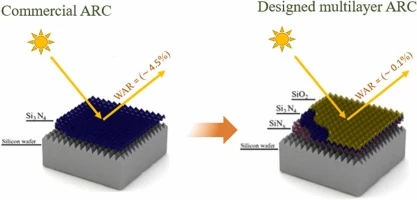
Common AR technologies include:
Single-Layer Coatings: Materials like MgF₂ or LiF reduce reflection to below 5% for specific wavelengths. However, their limited spectral range and mechanical fragility restrict broader use .
Multi-Layer Coatings: By stacking materials like SiO₂/TiO₂ or MgF₂/ZnS, reflection losses drop to <1% across 450–750 nm wavelengths. Double-layer designs improve PCE by 19–31.8% in multi-junction cells .
Microstructured Films: Inspired by moth-eye nanostructures, these coatings offer ultra-wide angular and spectral performance. For example, textured MAPbI₃Br₃−ₓ cells with moth-eye patterns achieve a 13.4 mA/cm² rise in short-circuit current .
U-Sunny's T-6141 Low-Refractive-Index Resin: A Breakthrough in AR Technology
Shenzhen U-Sunny, a leader in UV-curable materials, has developed the T-6141 resin, a low-refractive-index solution optimized for solar applications. Key advantages include:
Refractive Index Tuning: With a refractive index (nD) <1.45, T-6141 minimizes interfacial reflection, enhancing light transmission by up to 98% .
Durability: The resin withstands temperatures up to 200°C and harsh environmental conditions, ensuring long-term stability in outdoor installations .
Rapid Curing: UV-curable properties enable <30-second processing, reducing manufacturing costs and enabling scalable production .
In comparative tests, double-layer coatings using T-6141 and MgF₂ reduced reflection to <2% across 350–1800 nm wavelengths, outperforming traditional SiO₂/Si₃N₄ designs .
Commercial Benefits of AR Coatings
Higher Energy Yield: AR-treated panels generate 10–15% more electricity daily, accelerating ROI for residential and utility-scale projects .
Extended Lifespan: Coatings protect cells from dust, humidity, and UV degradation, reducing maintenance costs by 20–30% .
Compatibility: AR layers integrate seamlessly with hybrid inverters and bifacial modules, future-proofing solar systems .
Future Trends and Innovations
Research is focusing on graded-index coatings and bio-inspired nanostructures to achieve near-zero reflection. For instance, Rensselaer Polytechnic Institute's 7-layer AR coating achieves 96.21% absorption across all solar angles, eliminating the need for sun-tracking systems . Meanwhile, U-Sunny is advancing flexible AR films for perovskite and organic PV cells, targeting efficiencies above 25% .
Conclusion
Solar anti-reflective layers are indispensable for unlocking the full potential of photovoltaic systems. Innovations like U-Sunny's T-6141 resin exemplify how material science can drive efficiency gains while lowering costs. As the industry shifts toward multi-junction and tandem cells, AR coatings will remain a cornerstone of solar energy advancement.