


1. Core technical characteristics of PAS-33
PAS-33 is a photosensitizer developed based on anthraquinone derivatives. Its original design is to improve the comprehensive performance of cationic curing systems. According to technical parameters, the product has the following outstanding characteristics:
1. High-efficiency light response ability
PAS-33 has an absorption wavelength of 410nm, which can be extended to 470nm at most, covering the visible light to near-ultraviolet spectrum range. This feature enables it to fully absorb light energy, quickly activate cationic polymerization reaction, and significantly shorten the curing time.
2. Excellent compatibility
As a highly compatible cationic initiator, PAS-33 can be stably combined with a variety of resin systems (such as epoxy, vinyl ether, etc.), avoiding the phase separation or uneven curing problems caused by poor compatibility of traditional initiators. Its 100% polymer solid content further ensures the flexibility of formula design.
3. Deep curing and thick film applicability
PAS-33 can still achieve uniform deep curing in thick films (>100μm) or high pigment content systems. Its low viscosity (150 cPa·s at 25°C) and moderate density (1.02 g/cm³) help achieve uniform penetration of light energy in complex structures.
2. Application scenarios: from industrial coating to electronic packaging
With its technical advantages, PAS-33 has shown wide applicability in multiple fields:
1. Industrial protective coating
In the fields of automobiles, aerospace, etc., protective coatings need to have high hardness and corrosion resistance. PAS-33 can form a dense cross-linked network under low temperature conditions by quickly initiating cationic polymerization, thereby improving the mechanical strength and chemical stability of the coating.
2. Electronic packaging materials
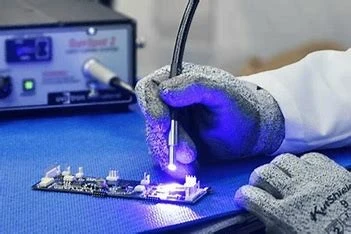
Light-curing packaging materials have extremely high requirements for curing depth and precision. The 470nm long-wavelength absorption ability of PAS-33 can penetrate translucent substrates (such as PCB boards) to achieve precise curing of internal structures and avoid thermal stress damage.
3. Colored system curing
Traditional cationic systems are susceptible to the shielding effect of pigments in colored formulas, while PAS-33 significantly reduces the scattering loss of pigments to light energy by optimizing light absorption efficiency, making it suitable for UV inks, colored adhesives and other scenarios.
3. Performance advantages: Double breakthroughs in efficiency and stability
Compared with the traditional free radical curing system, the cationic curing system driven by PAS-33 has achieved the following breakthroughs:
1. The curing rate is comparable to the free radical system
Experimental data show that under the same energy input, the curing rate of PAS-33 is comparable to that of the free radical system, breaking the inherent perception of "low efficiency" of cationic curing.
2. Stronger environmental adaptability
Cationic polymerization is insensitive to oxygen. PAS-33 is further designed with high compatibility to work stably in high humidity or oxygen-containing environments, broadening outdoor application scenarios.
3. Significantly improved economic efficiency
Due to the high utilization rate of light energy, the unit dosage of PAS-33 is 20%-30% less than that of traditional initiators, while supporting single-shot curing of thick films, reducing energy consumption and production costs.
IV. Future Outlook: Promote the Upgrading of Photocuring Technology
With the growing demand for green manufacturing, efficient and low-energy photocuring technology will become the mainstream. As a representative of highly compatible cationic initiators, PAS-33 not only solves the pain points of traditional systems, but also provides technical support for the development of new materials (such as bio-based resins and flexible electronic materials). In the future, its application boundaries are expected to further expand to emerging fields such as medical devices and 3D printing.
Conclusion
The launch of PAS-33 marks a new stage of cationic photocuring technology in terms of efficiency and generalization. Its high compatibility, rapid response and deep curing capabilities provide the industry with more competitive solutions. For companies pursuing production efficiency and product stability, this innovative product will undoubtedly become a key boost to optimize the process chain.