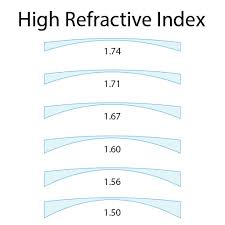
With the rapid development of consumer electronics, automobiles, medical and other fields, the demand for lightweight, high-transmittance, and impact-resistant optical lenses has surged. Traditional glass lenses are gradually being replaced by resin lenses due to their heavy weight and fragility, while high refractive index resin (High Refractive Index Resin) has become the core driving force for industry upgrades with its advantages of lightness, high optical performance and customizability. It is predicted that the global high refractive index resin lens market will grow at an average annual rate of 8.5%, and is expected to exceed US$20 billion by 2030.
Technological breakthroughs and performance advantages of high refractive index resins
1. Molecular design and refractive index improvement
High refractive index resins significantly improve the refractive index of materials (up to 1.67 or above) by introducing structures containing benzene rings or sulfur elements such as thiobisthiophenol and epoxy acrylate, while maintaining high transmittance (>85%) and low dispersion characteristics. For example, the 4'4-thiobisthiophenol-based epoxy resin developed by Zhang Jingran's team has achieved surface microstructure design through nanoimprinting technology, making the lens both anti-reflective and brightening, suitable for flexible displays and augmented reality (AR) devices.
2. Innovation in UV curing process
UV curing technology quickly polymerizes resin molecules through photoinitiators to form a dense structure. Compared with traditional thermal curing processes, its energy consumption is reduced by 50%, the curing time is shortened from several hours to several seconds, and there is no solvent volatilization, which meets green manufacturing standards. For example, the curing process using UV-LED light source can achieve high-precision coating, which is suitable for large-scale production of ultra-thin lenses (thickness <1.5 mm).
3. Multifunctional composite performance
Abrasion resistance and weather resistance: UV resin with high cross-linking density has a surface hardness of up to 2H (pencil hardness), and its scratch resistance is better than that of traditional materials, making it suitable for automotive lenses and outdoor optical equipment.
Lightweight and flexibility: Resin lenses weigh only 1/3 of glass, and can be flexibly bent by adjusting the formula, making them suitable for smart wearable devices and folding screen mobile phones.
Application scenarios: from consumer electronics to high-end medical care
1. Consumer electronics
Smartphones and AR/VR devices: High-refractive-index resin lenses are used in camera modules and display screens to improve image clarity and anti-reflection performance. For example, a certain brand of mobile phone lenses uses 1.67 refractive-index resin, which reduces thickness by 30% and increases transmittance to 92%.
Smart glasses: Lightweight resin lenses combined with anti-blue light coatings meet the needs of long-term wear, and the market share is increasing year by year.
2. Automotive industry
Onboard cameras and lidar: High-temperature resistant (>150℃) resin lenses ensure the stability of autonomous driving sensors, and anti-ultraviolet aging performance extends service life.
3. Medical and optical instruments
Endoscopes and microscopes: High-transmittance resins reduce optical distortion and improve the imaging accuracy of medical equipment.
Degradable lenses: Progress has been made in the research and development of bio-based resins, which may be used in disposable medical devices in the future to reduce environmental pollution.
The technological innovation of high refractive index resins has not only promoted the performance leap of optical lenses, but also become a benchmark for the chemical industry's transformation to green and intelligent. With the rise of emerging fields such as 5G communications and smart cars, this market will continue to release growth potential. Enterprises need to increase R&D investment and break through the bottlenecks of core formulas and processes to seize the 100 billion market with an average annual growth rate of 10%.