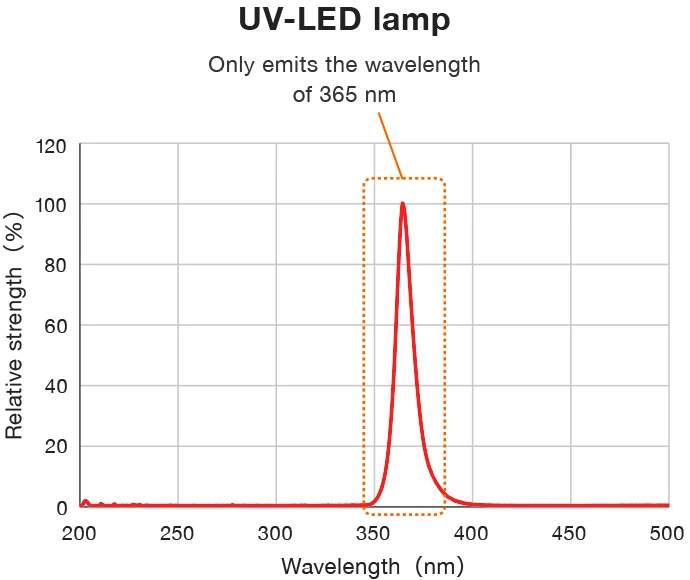
With the popularity of LED UV curing technology, **Long Wavelength UV Curable Resin** is becoming a core solution for electronic packaging, optical coatings and thick composite material manufacturing with its excellent penetration ability and material adaptability. Compared with traditional short-wavelength (such as 254 nm or 365 nm) resins, long-wavelength (385–405 nm) UV resins can penetrate pigments, plastic substrates and high-filler systems to achieve deep and uniform curing, while reducing thermal damage to the substrate, providing efficient and energy-saving curing options for complex industrial scenarios.
The U-9100A series resins launched by Shenzhen U-Sunny Technology are specially optimized for long-wavelength LED light sources (395–405 nm), achieve rapid curing at 300–400 mJ/cm² energy, and are compatible with high filler loads (such as 40% nano-silica). They have been successfully used in automotive optical components, 5G high-frequency circuit packaging, and biomedical microfluidic chip manufacturing, helping customers improve production efficiency by more than 35%.
Technical advantages and performance breakthroughs
1. Deep curing and high penetration
Long-wavelength UV resin breaks through the limitations of traditional curing through the following characteristics:
High energy penetration: 405 nm wavelength can penetrate dark substrates with a thickness of up to 5 mm or coatings containing 30% pigment, and the degree of curing is >95% (FTIR detection), avoiding the defect of "surface curing, internal unreacted".
Excellent thermal stability: The substrate temperature during the curing process is <50°C, which is suitable for heat-sensitive materials (such as PET film, engineering plastics).
Wide wavelength compatibility: Adapt to 365–405 nm multi-band LED light sources to reduce equipment upgrade costs.
2. Material compatibility and functional expansion
U-9100A resin of Youyang Technology adopts a cationic-free radical hybrid system, which has the advantages of two types of curing mechanisms:
Low shrinkage: volume shrinkage <1.5%, ensuring the dimensional stability of precision devices (tolerance ±10 μm)19.
High adhesion: Adhesion to glass, metal, ceramic and other substrates reaches 5B (ASTM D3359), and salt spray resistance test >72 hours.
Functional adjustability: By adjusting the monomer ratio, the modulus (0.5–3.0 GPa) and refractive index (1.48–1.55) can be flexibly adjusted to meet the needs of optical lenses and flexible circuits.
3. Environmental protection and process efficiency
Zero solvent formula: VOCs content <10 ppm, in line with EU REACH and China GB/T 38597-2020 standards.
Fast curing: Single layer curing time <3 seconds (energy density 350 mJ/cm²), support roll-to-roll (R2R) continuous production, production speed up to 30 m/min.
Industry applications and typical cases
1. Automotive electronic packaging
In the insulation coating of new energy vehicle battery packs, long-wavelength resin achieves a balance between deep curing and high temperature resistance:
Performance parameters: volume resistivity>1×10¹⁵ Ω·cm, arc resistance>180 seconds (ASTM D495).
Customer case: After a global TOP 3 battery manufacturer adopted U-9100A, the coating defect rate dropped from 5% to 0.3%, and the energy consumption of the production line was reduced by 40%.
2. Optical component manufacturing
High-transmittance curing for AR/VR optical waveguide components:
Technical breakthrough: transmittance>92% (@550 nm), haze<0.3%, and optical loss<0.2 dB/cm.
Mass production results: After a leading manufacturer introduced it, the lens yield increased from 78% to 98%.
3. Medical microfluidic chip
In the printing of the hydrophilic layer of the biological test paper, bubble-free filling and cell compatibility are achieved:
Key indicators: porosity <0.1%, cell survival rate >99.5% (ISO 10993-5).
Certification results: Passed FDA 510(k) pre-examination and became the core material of in vitro diagnostic equipment.
Market trends and technological innovation
According to Grand View Research data, the global long-wavelength UV resin market will exceed US$1.5 billion in 2030, with a compound annual growth rate of 12.5%. Future technological evolution focus:
Intelligent light source matching: Dynamically adjust wavelength and energy through AI algorithms, and reduce curing energy consumption by another 20%.
Development of bio-based materials: Using renewable monomers such as castor oil derivatives, the carbon footprint is reduced by 35% (U-Sunny has started pilot testing).
Nano-enhanced functionalization: Embedding MXene nanosheets to improve thermal conductivity (>1.2 W/m·K) and electromagnetic shielding effectiveness (>30 dB).
Long Wavelength UV Curable Resin is reshaping the process standards of high-end manufacturing through its breakthroughs in penetration and environmental performance. Shenzhen U-Sunny Technology (U-Sunny) relies on U-9100A series resins and customized solutions to provide end-to-end support from R&D to mass production for customers in the automotive, medical, optical and other fields. With the rapid development of green manufacturing and smart devices, this technology will continue to lead industry innovation in the fields of high precision and sustainability.