


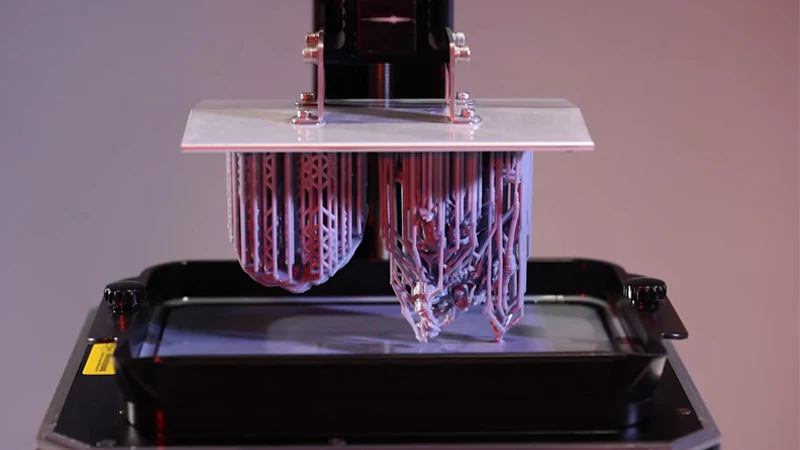
In the fields of medical, aerospace and consumer electronics, **Photopolymer Resin for 3D Printing** is becoming the core driver of precision manufacturing with its micron-level precision, rapid prototyping and material customizability. By combining photosensitive chemistry with advanced printing technology, this type of resin can achieve complex structures that are difficult to achieve with traditional processes, while meeting the needs of industrial mass production.
The U-9310 series of photosensitive resins launched by Shenzhen U-Sunny Technology is optimized for SLA/DLP/LCD technology, achieving 25 μm layer thickness accuracy at 405 nm wavelength, and only 300–400 mJ/cm² of curing energy. It has been successfully applied to the manufacture of dental invisible braces, microfluidic chips and aerospace lightweight parts, helping customers shorten the prototype development cycle by more than 60%.
Technical advantages and performance breakthroughs
1. Submicron printing accuracy
U-Sunny U-9310 series resins achieve precision manufacturing through the following innovations:
Low shrinkage formula: Volume shrinkage <0.8% (ASTM D2566), ensuring dimensional stability of fine structures below 50 μm.
High light transmittance: 405 nm wavelength transmittance >99%, supports ultra-thin layer thickness (10–25 μm) printing, surface roughness Ra<0.5 μm.
Wide viscosity adaptation: Viscosity range 200–1,500 cP (25°C), compatible with desktop to industrial printing equipment.
2. Functionalized material matrix
Biocompatibility: Passed ISO 10993-5 cytotoxicity test and FDA 510(k) certification, suitable for medical device printing.
High temperature tolerance: Heat deformation temperature (HDT) reaches 120°C (ISO 75), meeting the needs of automotive engine compartment components.
Adjustable flexibility: modulus range 0.1–3.0 GPa, elongation at break 5–150%, adaptable to all scenarios from rigid gears to elastic seals.
3. Green manufacturing and efficiency upgrade
Solvent-free environmentally friendly formula: VOCs emissions <10 ppm, in line with EU REACH and China HJ 2537-2014 standards.
High-speed curing capability: single-layer curing time <3 seconds (energy density 350 mJ/cm²), supporting continuous batch production.
Easy support removal: water-soluble support material dissolution rate >0.1 mm/min, reducing post-processing time by 50%.
Industry applications and customer cases
1. Customized medical implants
Printing bioactive resin coatings on the surface of orthopedic titanium alloy implants:
Technological breakthrough: pore size 50–200 μm is controllable, and cell adhesion rate is increased by 70% (ISO 10993-5 test).
Clinical results: After being adopted by a tertiary hospital, the patient's bone integration period was shortened from 12 weeks to 8 weeks.
2. Aerospace lightweight structure
Printing carbon fiber reinforced photosensitive resin for satellite brackets:
Performance parameters: density 1.2 g/cm³, specific strength 180 MPa·cm³/g, radiation resistance passed ASTM E595 test.
Customer case: After being adopted by an aerospace company, the weight of the parts was reduced by 35%, and NASA low outgassing certification was passed.
3. Consumer electronics micro-optical devices
Achieving nanometer-level precision in the manufacture of optical waveguide components for AR glasses:
Optical performance: refractive index 1.52–1.58 adjustable, optical loss <0.3 dB/cm (@850 nm).
Mass production data: After a leading manufacturer introduced U-9300P resin, the lens yield rate increased from 75% to 98%.
Technology Trends and Future Directions
According to Grand View Research data, the global photosensitive 3D printing resin market size will reach US$850 million in 2023, and is expected to exceed US$2.5 billion in 2030, with a compound annual growth rate of 14.7%. Technology Evolution Focus:
AI-driven intelligent formulation: optimize resin rheological properties through machine learning, and dynamically match printing parameters (layer thickness/light intensity/temperature).
4D printing integration: develop temperature-sensitive/photosensitive dual-responsive resins to achieve post-printing deformation self-assembly (deformation accuracy ±5 μm).
Space-grade material development: extreme temperature resistant (-200℃ to +300℃) resins, adapted to the in-situ manufacturing needs of the lunar base.
Photopolymer Resin for 3D Printing is reshaping the industrial landscape of high-end manufacturing through the synergistic breakthroughs in precision, functionality and efficiency. Shenzhen U-Sunny Technology (U-Sunny) relies on the U-9310 series of resins and vertical integration solutions to provide full-cycle support from design verification to mass production delivery for customers in the medical, aerospace, electronics and other fields. With the deepening of intelligent manufacturing, this technology will continue to release innovation potential in the fields of personalized customization and Industry 4.0.