


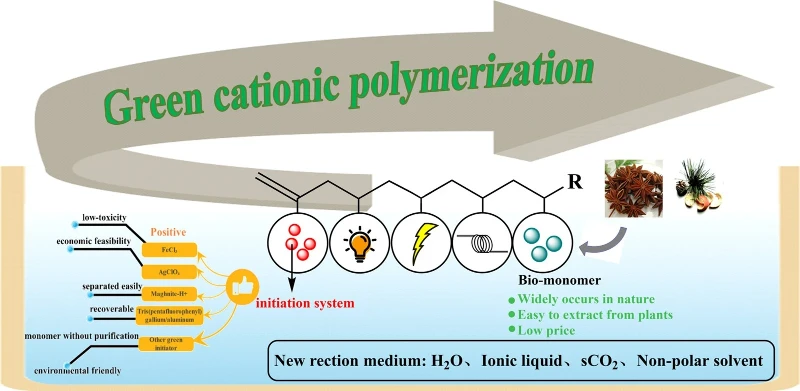
Driven by stricter environmental regulations and industrial efficiency upgrades, low-energy cationic polymerization technology is becoming a focus in the field of polymer materials. This technology uses light or heat to initiate cationic active centers to achieve rapid and energy-saving polymerization reactions, which is particularly suitable for sustainable production needs in industries such as coatings, inks and adhesives.
Technical principle: efficient and energy-saving chemical reactions
The core characteristics of low-energy cationic polymerization include rapid initiation, rapid chain growth, and frequent chain transfer. In its reaction system, Lewis acids (such as BF₃, AlCl₃) and co-initiators (such as H₂O) form ion pairs, and monomers (such as epoxy resins and vinyl ethers) are activated by protons or carbon cations. The reaction activation energy is only 8.4–21 kJ/mol, which is much lower than the 105–125 kJ/mol of free radical polymerization, so it can be completed at room temperature or low temperature conditions, significantly reducing energy consumption. In addition, the dark-curing nature of cationic polymerization allows the curing process to continue after light irradiation has stopped, which is particularly suitable for deep crosslinking of thick coatings or complex structured materials.
Application scenarios: from industrial protection to precision manufacturing
Coatings: Cationic photocurable epoxy resins are the preferred choice for protective coatings on metal and plastic surfaces due to their low shrinkage (<5%) and high adhesion. For example, automotive parts coatings can be cured quickly through this technology while resisting chemical corrosion and mechanical wear.
Ink industry: UV cationic inks exhibit the advantages of solvent-free evaporation (VOC-Free) and high color stability in printing, and are suitable for food packaging and electronic circuit printing.
Adhesive development: Cationic UV adhesives form a three-dimensional network structure after curing, have high temperature resistance (>150°C) and creep resistance, and are widely used in aerospace composite bonding.
U-Sunny PAS-12 photosensitizer: the key to improving photocuring efficiency
U-Sunny's PAS-12 is a multifunctional photosensitizer designed for low-energy cationic polymerization. Its core technologies include:
Broad wavelength absorption: Enhanced photosensitivity through hydroxyl polyol structure, compatible with UV-LED and mercury lamp light sources, and expanded the application of colored systems (such as carbon black coatings).
Electron transfer mechanism: PAS-12 absorbs light energy and is excited to the triplet state. It activates onium salt initiators (such as diaryliodonium salts) through electron transfer, significantly improving the acid production efficiency.
Environmental adaptability: It still maintains high reactivity under humid or oxygen-containing conditions and supports outdoor construction scenarios. Experiments show that the formula with the addition of PAS-12 can achieve full curing under low energy (<500 mJ/cm²) conditions, and the curing rate is comparable to that of traditional free radical systems, with a unit dosage reduction of 20%-30%. The product has been successfully used in 3D printing photosensitive resins and automotive high-gloss coatings, and customers have reported that it "significantly reduces energy consumption while improving coating toughness."
Industry Trends: Technology Substitution and Market Growth
The global coatings and adhesives market is accelerating its transformation to water-based and solvent-free. It is predicted that the demand for environmentally friendly adhesives will reach 950,000 tons in 2025, with a compound growth rate of 6.5%. Cationic polymerization technology has become an important choice to replace acrylate systems due to its low energy consumption and low toxicity. For example, the penetration rate of UV cationic coatings in the field of electronic packaging has exceeded 15%.
Conclusion
Low-energy cationic polymerization technology is reshaping the competitive landscape of the coatings, inks and adhesives industries through the combination of energy-saving processes and high-performance materials. As an innovative achievement in this field, U-Sunny PAS-12 photosensitizer not only promotes the green manufacturing process, but also provides companies with solutions to reduce costs and increase efficiency. In the future, with the development of 3D printing and smart materials, this technology is expected to show potential in more high-value-added fields.