


In the fields of medical devices, food packaging and precision electronics, free monomers in traditional UV adhesives are becoming a pain point in the industry - they are not only prone to skin sensitization and migration pollution, but also reduce the long-term stability after curing. The monomer-free UV resin T-7128 launched by Shenzhen U-Sunny has achieved a 100% active ingredient formula for the first time through molecular structure innovation, completely eliminating the risk of monomer residues and providing a safe and reliable bonding solution for high-end manufacturing.
1. Industry pain points of monomer-containing UV glue
Traditional formulas rely on 30%-60% active diluent monomers, which brings three hidden dangers:
Biosafety risk: methacrylate monomers can easily penetrate the skin and cause allergies, which does not meet the ISO 10993-5 medical device certification standard;
Migration pollution: unreacted monomers in food packaging glue will precipitate contaminated contents, and EU EU 10/2011 regulations strictly limit the migration amount to less than 0.01mg/kg;
Shrinkage stress out of control: The curing shrinkage rate of multifunctional monomers is as high as 8%-12%, resulting in micro-cracks at the glass-metal interface and a 40% decrease in peel strength.
2. Technological breakthrough of T-7128: Molecular design reshapes bonding logic
As a zero-monomer UV resin, T-7128 achieves "self-curing" capability through a two-functional polyurethane acrylate prepolymer:
Low viscosity and high permeability: viscosity 4500-5500mPa·s (25℃), can penetrate microporous structure without diluting monomers, and the contact angle to glass/metal is <15°;
Double bond direct connection technology: acrylate groups are directly bonded to polyurethane segments, the curing efficiency is increased by 70%, and the cross-linking density reaches 8.5×10⁻⁴mol/cm³;
Ultra-low acid value (≤3mgKOH/g): avoids corrosion of ITO conductive film and metal plating, and prolongs the life of electronic devices.
3. Application scenarios: high-value landing from medical to electronics
1. Medical device packaging
In TPU catheter bonding, T-7128 directly penetrates the surface of the material to form a covalent bond, with a peel strength of 8.5N/mm² (ASTM D903), while maintaining a 400% elongation at break of the material to avoid the risk of intravascular movement stratification.
2. High-frequency electronic bonding
The dielectric constant is stable at 2.8 (1MHz), the signal loss is <0.002, and it is suitable for bonding the glass substrate and aluminum alloy frame of the 5G millimeter wave antenna module, reducing the transmission delay by 35%.
3. Vacuum coating protection
As a primer in the glass electroplating process, it is resistant to strong acid (10% H₂SO₄ immersion for 240h without shedding), and the bonding strength reaches 5B, replacing the traditional chromate treatment process.
4. Process adaptation: Breaking the construction bottleneck of monomer-free formula
For the high viscosity characteristics of zero-monomer system, three major process parameters need to be optimized:
Substrate pretreatment
Sandblasting of metal surface Ra=1.5-2.0μm, wiping of glass with 0.5% HEMAP phosphate additive to improve wettability;
Curing equipment upgrade
Using 365nm+385nm dual-wavelength UV-LED light source (energy ≥1200mW/cm²), the penetration depth is increased to 1.2mm;
Glue dispensing control
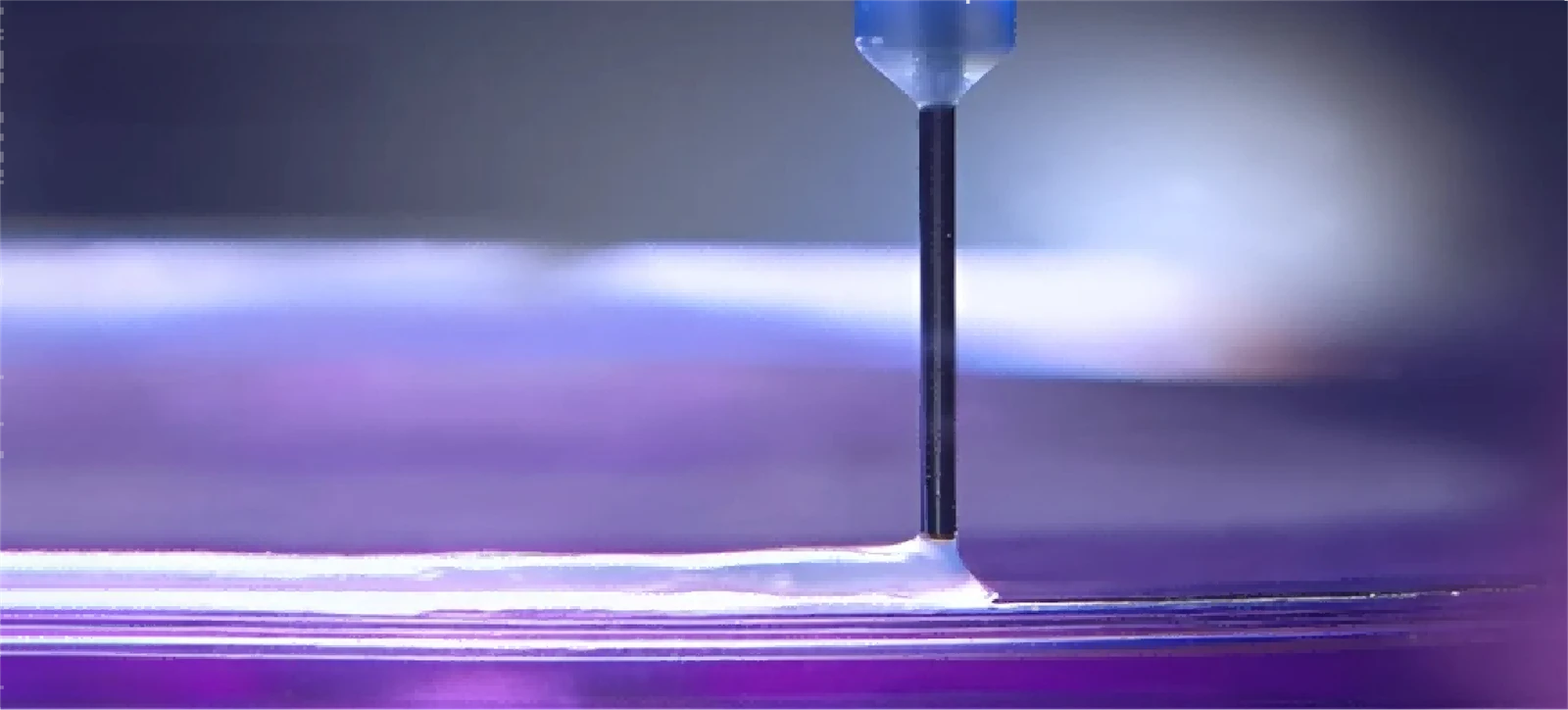
Glue layer thickness ≤0.2mm (pressure-sensitive tape application) or 10-30μm (optically transparent bonding) to avoid incomplete curing in low-energy areas.
5. Future Trends: Green and High-Performance Dual Tracks
Development of water-based monomer-free resin: Combined with the core-shell structure of T-7128, VOC emissions are reduced to below 50g/L, meeting the EMARK certification for automotive interiors;
Nano-enhanced formula: Adding 30nm fumed silica (dispersion conditions: 2000r/min×30min), wear resistance is improved by 80%, and the wear value is <15mg;
Light-thermal dual-curing extension: Introducing microcapsule latent curing agent into the shadow area, triggering secondary cross-linking at 130℃, and expanding to automotive structural parts bonding.
Conclusion
Monomer-free UV glue is not a simple formula subtraction, but a molecular-level reconstruction of materials science. T-7128 has achieved breakthroughs in medical safety, electronic signal integrity, coating durability and other scenarios through polyurethane acrylate prepolymer technology. With the maturity of nano-modification and water-based technology, "zero-risk" bonding will become the standard for high-end manufacturing.