


In cutting-edge fields such as new energy vehicle battery packs, medical catheters, and 5G ceramic antennas, the bonding and coating of low surface energy substrates (PP/PE/silicone), highly inert surfaces (glass/ceramics), and easily corroded metals (aluminum alloy/magnesium alloy) have long plagued the manufacturing industry. Traditional UV resins face three major technical barriers: insufficient adhesion, poor chemical resistance, and low process compatibility. The T-7130 high-adhesion UV resin launched by Shenzhen U-Sunny has broken through the limits through molecular-level design and has become a benchmark material for conquering difficult-to-bond substrates.
1. The ultimate challenge of difficult-to-bond substrates: Why do 90% of UV resins fail?
Analysis of the characteristics of four "stubborn" substrates
|
Base material type |
Surface energy (mN/m) |
failure mode |
Industry pain point cases |
|
sulan (PP) |
29-30 |
Coating shrinkage hole / grid detachment |
The bumper of new energy vehicle has bubbles on the UV coating |
|
silastic |
20-22 |
Surface peeling/sticking back |
The adhesive of the medical breathing mask is delaminated |
|
alumina ceramics |
45-50 |
Adhesion decreases in high temperature and humidity environment |
5G antenna filter silver paste layering |
|
magnesium alloy |
- |
Electrochemical corrosion causes the coating to bubble |
The drone shell failed after 72h of salt spray test |
|
Base material type |
Surface energy (mN/m) |
failure mode |
Industry pain point cases |
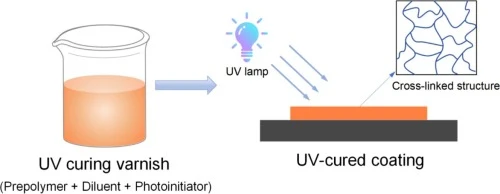
2. T-7130 resin: Four-dimensional technology reconstructs adhesion science
Innovative molecular architecture design
Core-shell oligomer structure:
Core: epoxy-acrylate rigid skeleton (provides hardness/chemical resistance)
Shell: polyurethane-phosphate flexible chain (penetrates substrate micropores for anchoring)
Dual curing mechanism:
UV main curing + moisture auxiliary curing, completely eliminating uncured residues in shadow areas
3. Industry application: Breakthrough practice from ink to pressure-sensitive adhesive
(1) New energy battery insulation ink
Challenge: Poor adhesion of UV printed characters on the surface of PP battery shell
Solution:
T-7130-based insulation ink directly prints PP shell
Passed 200℃ thermal shock +85℃/85%RH double 85 test
(2) Medical-grade silicone pressure-sensitive adhesive
Technological breakthrough:
UV pressure-sensitive adhesive with 15% T-7130 has an adhesion of 6.2 N/25mm to silicone
Biocompatibility certified by ISO 10993
(3) 5G ceramic antenna silver paste
Technological innovation:
T-7130 is used as a silver paste binder, and the sintering temperature is reduced from 850℃ to 150℃
4. Technology Frontier: Evolution of Smart Responsive UV Resins
4.1. Self-repairing Function
Microencapsulated Repair Agent: Self-repair at 60℃/10min after scratching (applied to automotive interior coating)
4.2. Conductive-insulating adjustable system
Compound PEDOT:PSS: Surface resistance 10³~10¹⁰ Ω/sq adjustable (flexible circuit direct writing printing)
4.3. Ultra-low temperature curing
Curing speed maintained at 80% at -40℃ (application of polar equipment repair glue)
Conquer your difficult-to-bond substrates now!
✅ Get free T-7130 samples + "Difficult-to-bond Substrate Solutions Manual"
✅ Technical support hotline: +86 13686844208