6000 mesh talcum powder has synergistic matting and permeability, and has a certain anti-settling synergistic effect.
6000 mesh calcined kaolin has synergistic matting and good hiding power. 6000 mesh barium sulfate has synergistic matting and good hiding power and comprehensiveness.
3000 mesh and above ATH (aluminum hydroxide) has synergistic matting, but it is easy to appear white in liquid state, fire retardant, good anti-settling property, good permeability after curing, good hiding power, and good synergistic whitening effect. 8000 mesh quartz powder has synergistic matting and good wear resistance.
3000 mesh and above ceramic powder has synergistic matting and good wear resistance, but poor permeability, and the dosage should be small.
Usually, only talcum powder is used for matting, followed by other powders added according to their functions, and the total amount is controlled at 3-10%. UV matte products need to pay attention to the dispersion time and temperature.
UV matte products should pay attention to the dispersion time and temperature. The dispersion time must be sufficient and the temperature must be between 30 and 60 degrees. If it is too low or too high, stratification will occur after dispersion, and the powder will float on the surface after curing, affecting many test indicators.
The best way is to grind the color paste with an appropriate amount of functional resin and inorganic fillers, pigments, etc., and then disperse it evenly with the matte resin. In this way, the obtained product, even if it is black, white, colorful, bright color or pearlescent powder, will have good curing, matting and comprehensive performance.
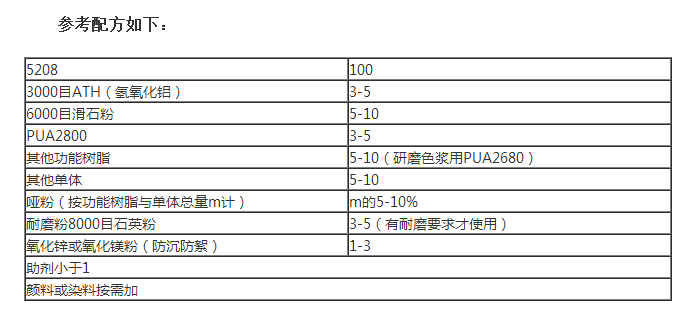
The matte powder content of matte resin 5208 itself is very high, and the powder with a grafting amount of more than 20% has fully considered the amount of matte powder in the subsequent application formula. In principle, matte powder does not need to be added, and full matte can be achieved by adding fillers.
If too much functional resin or monomer is added, when the amount of 5208 is limited, matte powder can be added at 5-10% of the total amount of other resins and monomers, and all others are matted with fillers.
Without 5208 or too little addition, the synergistic matting is not good, the formula is unstable, easy to precipitate, poor curing or poor comprehensiveness after curing. 5208 should be used as the main resin as much as possible.
Matt UV formula needs to consider viscosity Matt formula must fully consider viscosity, so even if hyperbranched resin grafting is used, its normal viscosity cannot be lower than 500mpas, it should be around 3000mpas. Too low viscosity has certain problems, too high viscosity has poor processability, which is not conducive to the design of matte product formula. Matt UV formula needs to consider deep curing Matt formula design must consider deep curing, therefore, resin 2800 with photosensitizer properties must be added, and active amines cannot be added. Experimental tests have shown that active amines are only good in surface drying, and have no effect on deep curing, synergistic curing, stabilizing photons, and reducing the amount of photosensitizers. In addition, there is an odor, and there is an odor after curing. The storage stability of the finished product is not good. Matt products are prone to powder separation and backlog during the final construction, and eventually form blocks, lumps, and dead plates.
2800 can achieve deep-level, dark or high-filler pigment system curing, especially LED curing, which can significantly reduce the amount of photosensitizer used and has good adaptability to photosensitizers.
Matte UV formulas should consider not using solvents, no odor, no harm to people, and no burning hands. Matt film should have a certain hardness, moderate wear resistance and feel, no powder after scratching, no white spots after scratching, and water-resistant, chemical-resistant and wiping-resistant.
Based on the above situation, an example is given: bamboo and wood flooring matte coating or ink
The gloss of the substrate itself is assumed to be 30-50 degrees, without primer, only sanding and polishing, assuming no water-based sealing primer, directly use UV transparent primer 3228, no atomic putty. Directly make matte coating, 5 microns thick/time, and do it 2 more times. 5208 is matched with 2800, and inorganic fillers are added to cooperate with matting, and UV lamps use 1173 and 184. TPO and ITX for LED are used in conjunction.
The formula can usually achieve a gloss of less than 5 degrees, and the high-quality formula is usually less than 3 degrees.
Functional resins mainly refer to high hardness 2680 or 2630, ultra-wear-resistant, water-resistant, chemical-resistant, alcohol-acetone-resistant 2268, and good LED light activity 1251 or 2251. In short, when designing UV matte products, traditional formulas cannot be used, and equal replacement cannot be made. Designs need to be made according to their basic principles. This is a new thing, and there is a lot of room for development. It is necessary to think carefully and find out the subtle differences, especially the uncertainty factors when traditional products are replaced. In this way, the designed products have extensiveness and broad spectrum.