


With the rapid development of foldable devices, flexible displays and miniaturized electronic products, flexible adhesives (Flexible Adhesive for Electronic Encapsulation) have become one of the core technologies in the field of electronic packaging. This type of material must simultaneously meet stringent requirements such as high elasticity, temperature resistance, and chemical corrosion resistance, while the market's demand for environmental protection, low residue and high transparency further promotes technological innovation. This article will explore the application trend of flexible adhesives in depth, and focus on analyzing the breakthrough performance of U-Sunny's T-7333 pressure-sensitive adhesive resin in the fields of inks, adhesives and pressure-sensitive adhesives.
1. Market demand and technical challenges of flexible electronic packaging
According to market research, the Asia-Pacific region accounts for 58% of the global electronic-grade pressure-sensitive adhesive (PSA) market, of which China contributes 38%, mainly driven by the growth in demand for smartphones, OLED displays and semiconductor packaging. Flexible electronics manufacturers prefer soft pressure-sensitive adhesives because they can adapt to curved surfaces and improve assembly efficiency. Core technical requirements include:
Wide temperature range stability: The material must maintain stable performance within the range of -50°C to 200°C to avoid delamination or cracking due to thermal expansion and contraction.
Low shrinkage: The volume shrinkage during curing must be less than 3% to ensure the dimensional accuracy of precision electronic components (such as optical films and flexible circuits).
High transparency and aging resistance: The transmittance must be close to the original color of the substrate, Gardner chromaticity ≤1, and there is no risk of yellowing after long-term use.
2. Technical advantages of U-Sunny T-7333 pressure-sensitive adhesive resin
As a leading company in the field of domestic light-curing materials, U-Sunny's T-7333 resin has become a benchmark product for electronic packaging adhesives due to its innovative molecular design:
Adhesion and flexibility: The elongation at break is as high as 85%, which can buffer deformation caused by temperature or mechanical stress and avoid cracking of the coating.
Heat resistance: The glass transition temperature (Tg) is as low as -45°C, ensuring that the bonding strength can be maintained in extreme environments.
Low shrinkage and high light transmittance: The curing shrinkage is extremely low, suitable for film substrates such as PET and PC, and the light transmittance is close to water white and transparent, meeting the high-precision requirements of display screen protective films.
Multi-scenario compatibility: It can be used in conjunction with materials such as epoxy resin and polyurethane, and is suitable for industrial adhesives, functional coatings and UV ink formulas.
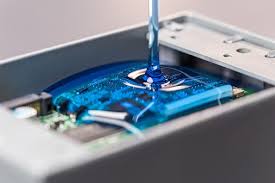
3. Collaborative application cases of ink, adhesive and pressure-sensitive adhesive
Ink field: T-7333, as a UV ink additive, can reduce the curing shrinkage, enhance the adhesion to plastic film, and improve the scratch resistance of the ink layer, which is suitable for flexible circuit printing.
Electronic packaging adhesive: In smartphone manufacturing, T-7333 is used for camera module fixation, FPC antenna bonding and other scenes. Its fast curing characteristics (UV curing within 30 seconds) significantly improve production efficiency.
Pressure-sensitive tape: As the main resin, T-7333 gives the tape high initial adhesion and balanced cohesion, which is suitable for medical tapes, self-adhesive labels and other reusable tearing and sticking scenes.
Technological innovations in flexible adhesives are driving electronic packaging toward lightweight and high reliability. U-Sunny's T-7333 pressure-sensitive adhesive resin provides the industry with efficient solutions through breakthrough performance and multi-scenario applicability. As the global demand for sustainable manufacturing increases, materials that combine high performance with environmental advantages will become the mainstream of the market.